
How Anthropic builds AI agents that collaborate and learn
ClaudeNovember 24, 2026Watch the video
Anthropic built the infrastructure behind Claude Managed Agents three times before making it available to customers. Along the way, the team learned how to organize AI agents so they could work more independently, efficiently, and reliably.
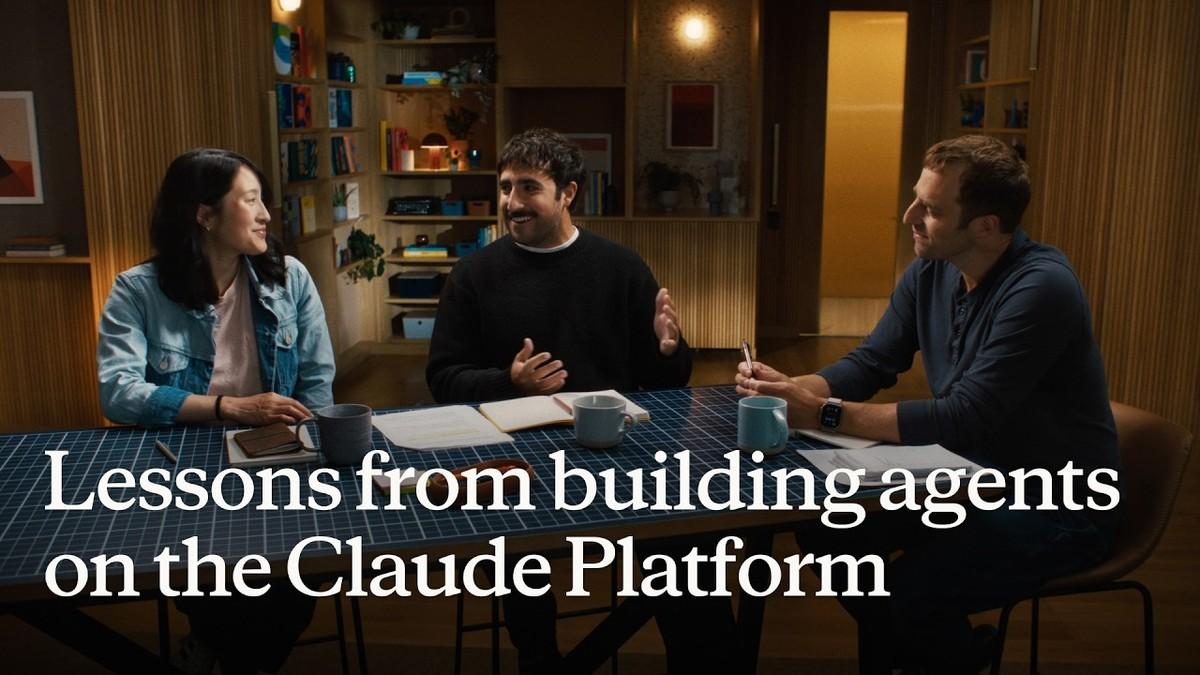
In the video “Lessons from building agents on the Claude Platform,” Anthropic’s Jess Yan, Michael Cohen, and Lance Martin share what they learned and offer advice for others building agent systems.
In brief
- Anthropic separated the agents’ reasoning from the environment where they carry out tasks.
- Agents can create workflows and coordinate other AI agents.
- One system can use different AI models to keep costs down.
- Through dreaming, agents can review and organize what they learned from earlier tasks.
- Anthropic designed the infrastructure to evolve alongside the models.
What is Claude Managed Agents?
To carry out tasks independently, an AI model needs access to tools, files, and memory, as well as a system that manages how it does the work.
The system around the model is called an agent harness. If the AI model is a car’s engine, the harness is the rest of the car.
Claude Managed Agents provides that infrastructure as a hosted service. Developers can focus on what they want their agents to do, which tools they can use, and what rules they need to follow.
Agents can look up information, run code, create and edit files, communicate with external systems, and take on tasks that run for extended periods.
The infrastructure needs to evolve with the models
Anthropic found that workarounds for a model’s limitations can become unnecessary or get in its way as models improve.
An earlier Claude model tended to end tasks prematurely as it approached the limit of how much information it could handle at once. Anthropic added a mechanism to keep this from happening.
A newer model no longer needed that mechanism.
If you design a system around what AI struggles with today, that system may limit what AI can do tomorrow.
AI agents that coordinate other agents
Traditional automated workflows consist of predefined tasks, sequences, and conditions.
With dynamic workflows, an AI agent can write a program that coordinates how other agents work together on a task.
A company could, for example, ask an AI agent to review several hundred supplier contracts for ways to cut costs. The agent could divide the contracts among several agents, have them work in parallel, compare the results, and compile the findings into a single report.
The workflow can adapt to the task and to the volume and complexity of the information. You can describe what you want to accomplish and set the boundaries within which the AI organizes the work.
Anthropic separated the brain from the hands
Anthropic divided the architecture into three parts.
- The brain is the AI model and the system that handles reasoning, planning, and tool use.
- The hands are the tools and environments where the agent runs code, edits files, or retrieves information from a database.
- The session keeps a record of tasks, actions, and results.
These parts were previously more tightly coupled. If the agent’s working environment failed, it could lose the entire session.
By separating the parts, the system can resume tasks after a failure, connect agents to different environments, and keep credentials separate from the code agents run.
This also makes it easier to add agents without giving each one a complete runtime up front.
Different AI models can reduce costs
Agents working together can use different AI models.
A smaller, cheaper model can sort information, extract data, or classify documents. A more capable model can handle analysis, planning, and problem-solving.
Anthropic also offers session budgets. Once a session reaches its cap, the agents pause before starting another model request.
AI agents that learn through dreaming
As an AI agent works, it can store what it learns in persistent memory. Over time, that memory can accumulate duplicates, errors, contradictions, and outdated information.
Dreaming is a separate process in which AI reviews past sessions and existing memory to identify patterns, correct information, and organize what the agents have learned.
After handling hundreds of support requests, an agent might have records of which problems customers run into most often, which solutions work, and which steps lead to mistakes. Dreaming can consolidate those observations so the agent can use them in future tasks.
Dreaming improves the information the model can draw on. The model’s weights stay the same.
How companies already use it
Anthropic cites several companies that use Claude Managed Agents.
Netflix uses multiple agents to analyze technical logs and find recurring problems across systems.
Harvey, which builds AI tools for legal work, uses agents to collaborate on complex documents and carry forward what they learn between tasks.
Wisedocs uses AI agents to review documents and check the results against predefined quality standards.
From automation to systems that organize their own work
Traditional automation has computers follow processes people have defined. With AI agents, systems can also plan tasks, organize workflows, delegate work to other agents, and use what they learned on previous tasks.
People can spend more of their time defining goals, setting boundaries, granting access, and checking results. This still requires safeguards, cost controls, and human oversight when mistakes could have serious consequences.
Claude Managed Agents and dynamic workflows are available in beta. Dreaming is a research preview with limited access.