
When AI Can Do the Schoolwork, What Should Students Learn?
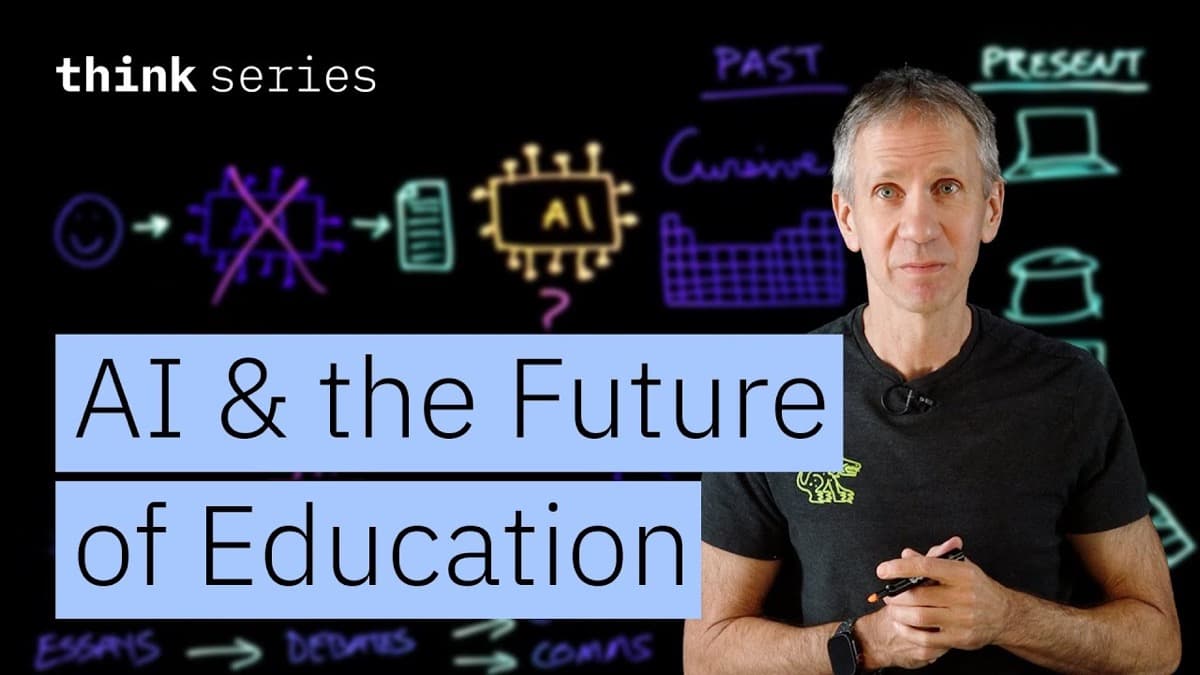
When a chatbot can write a homework assignment, it becomes harder to know what the student has actually learned. Jeff Crume believes the solution is to change what schools ask students to do, rather than trying to keep AI out.
Crume is an IBM Distinguished Engineer and Master Inventor, and also teaches at North Carolina State University as an adjunct professor, an American term for a part-time university instructor.
This article explains his arguments in a video from IBM Technology. The sections marked Commentary contain my own assessments and elaborations.
Generative AI means AI systems that can create new content, such as text, images or code, based on instructions from the user.
In Brief
- Jeff Crume believes schools should teach students to use AI, rather than trying to keep the technology away from them, and prepare students to use these tools in the workplace.
- Foundational knowledge is still necessary, but understanding, critical thinking and problem-solving become more important when AI can do parts of the work.
- AI can provide individual guidance and reduce teachers' workload. How the system is used and which sources it relies on matter.
- Students need AI literacy: They must understand the possibilities, the limitations and when answers should be checked.
- Critical thinking is also important outside school, where AI can make fraud and misinformation more convincing.
The Problem with the Traditional School Assignment
Crume starts with his own experience as an instructor. When he first saw how good modern AI chatbots had become at writing text, he thought it no longer made much sense to give students a conventional homework assignment in which they simply submitted an essay. The problem was straightforward: He could not know whether he was assessing the student's work or the chatbot's.
Many schools and teachers responded to this development by trying to ban AI or by using systems intended to detect AI-generated text. Crume believes this is a battle the education system cannot win. AI systems will continue to improve. Over time, it will become increasingly difficult to distinguish between text written by a human and text created or edited by AI.
He therefore believes the fundamental question needs to change.
Instead of asking: How do we stop students from using AI?
schools should ask: How can we use AI in a way that helps students learn more?
This also means that some forms of assessment need to change.
Schools Have Changed Before
Crume uses several historical examples to explain his thinking.
Schools used to spend a great deal of time on handwriting. Students learned cursive, and good handwriting could practically be a subject in its own right. Today, most written work is produced on computers. This does not mean that being able to write by hand is worthless. But society has changed, and so has the amount of teaching time we devote to the skill.
He uses memorization as another example. Crume says he had to memorize large parts of the periodic table himself. But when information such as the atomic numbers of elements can be looked up in seconds, he believes it is more valuable to spend teaching time understanding how the periodic table is organized and why that organization matters.
The same applies to arithmetic. Students must understand basic arithmetic, meaning ordinary calculations involving addition, subtraction, multiplication and division, among other things. But once a student understands the principles, it is not necessarily useful to spend enormous amounts of time performing complicated calculations manually if a calculator will be used in practice. The time can instead be spent on algebra, calculus, logic and problem-solving.
Map reading is a third example. Being able to read a traditional map can still be useful, but most people today use GPS for navigation.
Crume uses these examples to demonstrate a broader principle: When our tools change, we must also consider which skills schools spend the most time on.
This Does Not Mean Foundational Knowledge Disappears
This is an important distinction in his argument. Crume is not saying students should stop learning to write, calculate or understand science because a machine can help them. He distinguishes between understanding a skill and spending a great deal of time performing it mechanically.
A student should understand how division works. But once that understanding is in place, large parts of subsequent instruction do not necessarily need to consist of manual long division. Similarly, a student should understand what the periodic table shows without necessarily being able to recall every piece of information from memory.
In this line of thinking, AI becomes the next tool in the same development. The question therefore becomes what people should learn when machines can perform more and more parts of the work.
Critical Thinking Becomes the Most Important Skill
Crume highlights several qualities he believes will be important in a world with AI. Students must be flexible and able to adapt to new tools and ways of working. They must be creative because AI opens up possibilities that did not previously exist.
But above all of these, he places one skill: critical thinking.
Here, critical thinking means being able to examine information rather than simply accepting it. An AI system can give an answer that sounds convincing but is still wrong.
Students must therefore be able to ask:
- Is this correct?
- How can I check it?
- Where does the information come from?
- Is there supporting evidence?
Even when an answer is factually correct, another question may be necessary: Is this actually a good idea?
And then: What might the consequences be if we do this?
Crume thus emphasizes that AI does not remove the need for human judgment. It may instead make judgment more important.
AI can produce suggestions. Humans must decide what is true, relevant, sensible and responsible.
A Personal AI Tutor for Every Student
One of the possibilities Crume is most positive about is personalized teaching. A teacher with many students cannot always sit beside one student until the problem is understood. An AI tool can give the student more explanations without the teacher having to be present all the time.
If a student does not understand a mathematical explanation, a personal AI tutor can try again.
It can explain the problem more simply. It can use an example. It can use an analogy. It can break the problem down into smaller parts.
If that still does not work, it can try another method. The student can ask for more explanations, but that does not in itself mean the explanations are correct or that the student learns more.
This is what makes personalized AI-based teaching interesting to Crume. Students do not necessarily learn in the same way or at the same pace. A good AI tutor can therefore adapt the explanation to the person in front of it.
At the same time, Crume emphasizes that this does not remove the need for the teacher. The AI tool becomes a supplement that can give the student more individual help than the teacher alone has time to offer.
This describes a possible use of AI, not evidence that every AI tool improves learning. The benefit depends, among other things, on the quality of the tool, how it is used and the teacher's follow-up. UNESCO's guidance on generative AI in education emphasizes privacy, age-appropriate use and pedagogical evaluation of the tools.
But AI Makes Mistakes
An obvious objection arises here. How can we use AI as a teacher or tutor when generative AI models can be wrong? The short answer is that the problem is real.
AI models can produce incorrect information even when the language sounds highly convincing. When a model invents information in this way, the term hallucination is often used.
But it is also important to distinguish between different ways AI is used. “AI” is not one particular system with one particular level of quality. Which model is used, what instructions it receives, which sources it has access to and how the entire system around the model is built can have a significant impact on the result.
CommentaryThe Question Is Not Just Whether AI Makes MistakesRead the commentaryClose the commentary
When a school considers AI in teaching, it is not enough to ask: Can AI make mistakes? It can.
We should also ask: Which AI are we using, what is it allowed to do, which sources does it use, and how is it instructed to help the student?
There is a big difference between opening a random free chatbot and using a system that has been selected and configured specifically for teaching.
Different AI models have different strengths and weaknesses. Some are better at advanced reasoning. Others are faster or cheaper. Certain models may be better suited to particular subjects or tasks.
A free and a paid version of an AI service may also provide access to different models and features. Paying does not automatically mean the answer is correct, but which model the student actually has access to can matter.
The same applies to the instructions. An ordinary chatbot may be designed to answer the question as efficiently as possible. An AI tutor for students can instead be instructed not to give the answer straight away.
It can be told to ask the student questions. It can ask the student to explain how she was thinking. It can give one hint at a time.
It can identify where the student is stuck and explain that particular part differently. It can challenge the argument instead of finishing the text.
This means the same underlying AI model can be used in very different ways.
AI Can Work with the School's Own Sources
Another important question is where the knowledge the AI system will use comes from. A school does not necessarily need to let AI answer freely about everything based on what the model learned during training. It can also be given access to a controlled set of sources, such as the school's textbooks, curricula, teaching materials or other approved documents.
A common method for this is called RAG, which stands for Retrieval-Augmented Generation. The name sounds complicated, but the principle is quite simple.
Before AI answers, the system searches the documents it has been given access to and finds information relevant to the question. The model then uses this information when it creates its answer.
This means the answer can be more firmly grounded in material the school itself has selected. The system can also be built so that the student can see which documents or sources the answer is based on.
This does not make errors impossible. But it can make the system more controlled and the answers easier to check.
Does the School Need to Build Its Own AI Model?
Not necessarily. Training a large AI model from scratch requires enormous amounts of data, computing power, expertise and money. That is probably not something an ordinary school should do.
A more realistic solution may be to use an existing foundation model and build the school's own system around it.
Put simply, it can look like this: AI model + the school's instructions + approved sources + rules and safety mechanisms = the school's AI tutor
A school can therefore create an AI solution adapted to teaching without having to develop the foundation model itself.
Learning Exactly When You Need It
Crume also highlights what is called just-in-time learning. It simply means being able to learn something exactly when the need arises.
If you already have basic knowledge of a subject but suddenly need to understand a particular concept, you can ask AI and get an explanation immediately. You do not need to wait until the next lesson, search through a textbook or find an entire course. AI can act as a knowledge resource that is always available.
This does not replace the need for foundational knowledge. You still need a foundation to understand what is being explained. But AI can make it easier to fill small gaps in knowledge as they arise.
AI as an Editor
Crume also believes AI can be used in a way that resembles a personal editor. Here, AI is really building on tools we have already used for many years. Word processors have long had spelling and grammar checks.
Microsoft Editor can help with spelling and grammar; some more advanced style suggestions require a Microsoft 365 subscription. On compatible Apple devices, Writing Tools can, among other things, proofread and summarize text.
Generative AI can take this a step further. It can do more than say: This is wrong.
It can also say: This is wrong. Here is why. Here is the rule that applies. Here is a new example. Now you can try correcting the next sentence yourself.
The tool then moves from ordinary proofreading to potentially becoming part of the teaching itself. The student writes the text themselves.
AI can find spelling errors, grammatical errors or unclear wording. But instead of simply correcting them, the system can explain why something should be changed.
For the teacher, this can also reduce the time spent correcting the same basic mistakes over and over. The teacher can instead spend more time on the content, the argument and the understanding the student demonstrates.
AI as a Teaching Assistant
Crume uses teaching assistants himself, often called TAs at American universities. TA stands for teaching assistant. A teaching assistant can, among other things, help the teacher with grading, practical tasks and other routine work.
Crume asks what happens if AI can take over some of these tasks. AI can, for example, help create lesson plans, prepare materials or handle certain types of assessment.
His point is not just to save work. If the teacher spends less time on routine tasks, more time can be spent on what the teacher is particularly important for: understanding students, following up with them, explaining difficult concepts and thinking through what they should actually learn.
AI Can Also Be an Opponent
Another use Crume suggests is to let the student argue against AI.
Imagine a student preparing for a debate. AI can help the student with research and suggest arguments. But the student must decide which arguments are good.
The student can then ask AI to argue for the opposing side. AI can challenge the reasoning, find weaknesses and ask difficult questions. The student must defend their position.
AI is then used not to avoid thinking, but to create more thinking. This is a very different use of the technology from asking a chatbot to write a finished answer.
CommentaryAI Can Both Reduce and Increase the Amount of ThinkingRead the commentaryClose the commentary
An important distinction is whether AI takes over the thinking or helps the student think for themselves. Imagine two students using exactly the same AI system.
The first writes: Write the assignment for me.
AI does the job, and the student submits the result.
The second writes: Do not give me the answer. Ask questions that help me arrive at it myself. Find weaknesses in my arguments and challenge me when the reasoning does not hold up.
In one case, the same technology can reduce how much the student thinks, and in the other it can make the student think more.
The question of AI in education should therefore go further than: Does the student use AI?
A better question may be: What does the student use AI for, and how is AI designed to help the student?
Perhaps We Need to Change the Assignments
This brings Crume back to assessment. If a student can get AI to write an essay at home, it may become less useful to measure learning through these assignments alone.
He does not suggest removing essays entirely. Writing yourself is still a valuable activity. But he believes education can spend more time on activities in which students actually have to demonstrate their understanding.
A debate is one example. The student must understand the topic, listen to the counterargument, formulate a response and react on the spot. AI may have been used in preparation, but when the discussion takes place, the student must be able to think for themselves.
This tests different skills from a traditional essay: critical thinking, communication, argumentation and the ability to reason quickly.
AI Can Give More Students Access to Individual Help
Crume also highlights the differences between students. Some families can afford private tutoring, expensive learning materials and other resources. Others cannot.
An AI service running in the cloud can, in principle, be available to anyone with a browser and internet access. The cloud here means that the AI system itself runs on large computers elsewhere, while the student uses it through the internet.
Crume believes this can contribute to greater equity in education, meaning that more people gain access to learning resources that previously only some could afford or had the opportunity to use. This is particularly relevant in classes where one teacher is responsible for so many students that individual follow-up is difficult.
An AI tutor cannot replace the teacher, but can make individual help available more often. AI can also improve accessibility for students with different disabilities or learning needs, for example by converting text to speech or describing visual content aloud.
But Students Must Understand AI
If AI is to become a natural part of education, Crume believes AI literacy will be necessary. AI literacy does not primarily mean being able to program an AI model. It means understanding the technology well enough to use it sensibly.
- What is AI good at?
- What is it bad at?
- When can we trust an answer?
- When should we check it against other sources?
- What kinds of mistakes can the system make?
- Which model am I using?
- Which sources does it have access to?
- Is the AI tool designed for the task I am using it for?
- What should AI be used for, and what should people do themselves?
This becomes important precisely because AI can produce answers that look highly convincing. Being able to use AI is therefore not the same as being able to write an instruction and copy the answer. It also requires the user to be able to assess the result.
“Just Because We Can Does Not Mean We Should”
Crume teaches computer science students, among others, and highlights a rule he believes is particularly important in the AI age: The fact that something is technically possible does not automatically mean it is the right thing to do.
He therefore believes teaching about AI must also include ethics. Students should learn to think through unintended consequences, meaning effects that arise even though nobody planned them.
- Who is affected if we use AI in this way?
- Could someone be harmed?
- Can the system be used in a way it was not intended for?
- What happens to society if the technology is adopted on a large scale?
Crume connects this to concepts such as responsible AI and trustworthy AI. This is about developing and using AI in ways that consider safety, consequences and human responsibility, among other things.
From Remembering Answers to Understanding Principles
The common thread in Crume's argument is that students should spend more time understanding and evaluating. When AI suggests arguments or writes a text, the student must be able to decide whether the content holds up.
This is often called higher-order thinking: analyzing, comparing, applying knowledge, drawing conclusions and making independent judgments, rather than simply remembering and repeating information.
Students Will Enter a World Where AI Already Exists
Crume believes it is unrealistic to educate students as though AI does not exist when they will encounter the technology in the workplace. They should learn when it is useful, how it is used and how to check the answers.
For him, this is about what education is for: less mechanical work and more understanding, problem-solving, creativity, communication, ethics and critical thinking.
CommentaryPerhaps This Is the Most Important Skill the AI Age RequiresRead the commentaryClose the commentary
The challenge also extends beyond school. AI gives us more powerful tools, but also makes it easier to get answers without understanding them and to encounter text, images and voices that seem credible without being so.
Students therefore need more than unrestricted access to the technology. They must understand the possibilities and limitations, choose tools that fit the task and be able to check the sources.
And perhaps most important of all: They must learn when AI helps them think, and when they need to pause and think for themselves.
AI does not make human thinking unnecessary. The more powerful the technology becomes, the more important good human thinking may become.
The Most Important Takeaways
- AI changes the assignments, but does not remove the need for foundational knowledge. Students need understanding to be able to use the tools and assess the answers.
- How AI is used is crucial. A tool can do the assignment for the student or support the student in reasoning and finding the answer themselves.
- Critical thinking and AI literacy belong together. Students must be able to check sources, spot errors and assess when AI is suitable.
- Schools should prepare students for a workplace with AI. This means learning both how the tools are used and what responsibility people still have.
CommentaryCritical Thinking Becomes Important Far Beyond SchoolRead the commentaryClose the commentary
The need for critical thinking extends far beyond education. We will encounter AI-generated content throughout society. AI can already create text, images, audio and video that can be difficult to distinguish from material made by humans.
This means critical thinking is not only important when a student checks an answer from a chatbot. It also matters when an adult receives a strange text message from their bank, sees a startling image on social media, gets a phone call in which the voice sounds like a family member or encounters a highly convincing news story online.
AI can be used for useful purposes, but the technology can also make fraud, manipulation and misinformation more convincing.
Questions like these therefore become increasingly important:
AI therefore does not make critical thinking less important because we can ask a machine for answers. It may make critical thinking more important than ever, precisely because it is becoming easier to produce information that seems credible, whether or not it is correct.
Critical thinking is therefore not just a school skill. It becomes a fundamental skill for functioning in a society with AI.