
The Creator of Ruby on Rails Stopped Writing Code. Now He Wants to Challenge the Software Industry
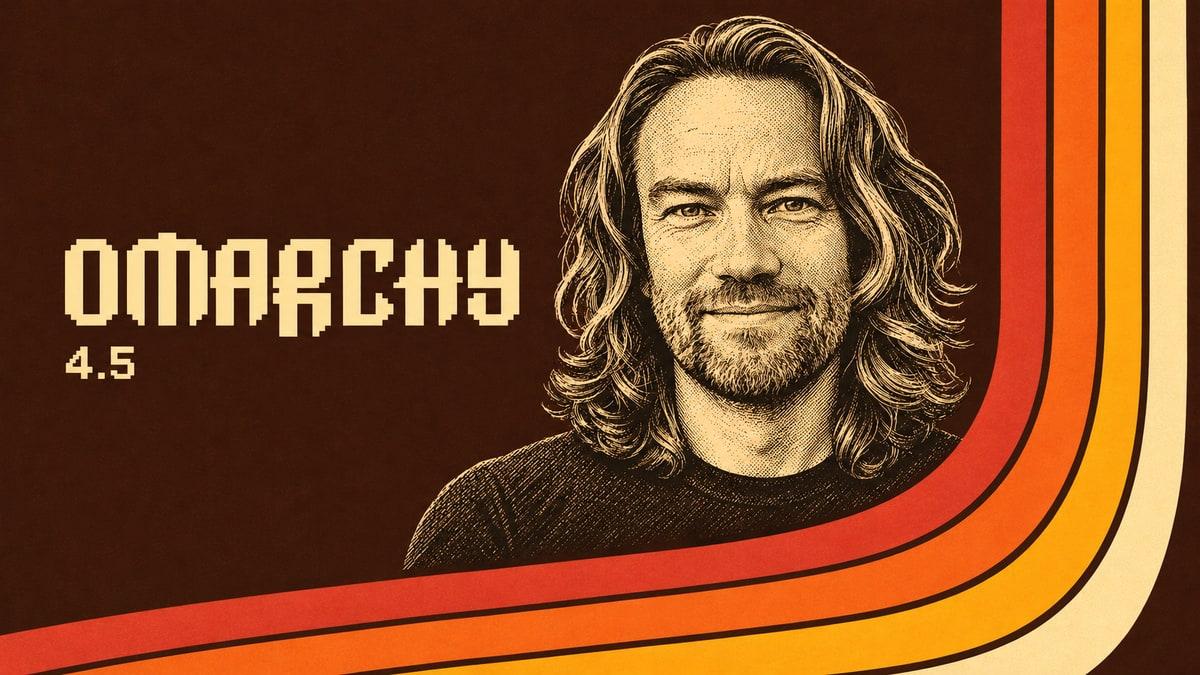
a16zMartin Casado and Anish Acharyawith David Heinemeier HanssonNovember 20, 2026Watch the video
David Heinemeier Hansson has spent around 30 years developing software. He has now stopped writing code by hand and turned that work over to AI agents. He thinks Windows and macOS are poorly suited to this way of using computers. He also believes AI can help us build our own alternatives to more of the software we pay for. With his Linux distribution Omarchy, he wants to show how computers could work in the future.
In January 2026, David Heinemeier Hansson was still skeptical about how much programming AI agents could take over. He thought the technology was impressive but too unreliable to replace experienced developers.
Eight months later, he stood in front of around a thousand developers at Rails World in Austin and told them that his company, 37signals, had decided to stop writing code by hand.
They had already made the switch.
In a new interview with venture capital firm Andreessen Horowitz (a16z), published November 20, he goes further. He argues that AI agents could change the entire software industry, make existing operating systems less relevant, and let individuals build software that once required large development teams.
From a renowned programmer to working with AI agents
David Heinemeier Hansson, a Danish developer known as DHH, created Ruby on Rails in 2003. The framework made it easier and faster to build web applications and has been used by companies such as GitHub, Shopify, Airbnb, and Coinbase.
He is also a co-owner and CTO of 37signals, the company behind the project management tool Basecamp and the email service HEY. He and Jason Fried have written several books on technology and business, including Rework and Remote.
DHH has helped shape how software has been built for much of the past two decades.
Now he thinks the work of programming itself is changing.
A developer used to translate an idea into code, choose the right technologies, solve technical problems, and write the instructions the computer would follow. AI agents can now take on much of that work.
The developer describes the desired outcome. The agents write the code, run tests, investigate errors, and suggest improvements.
DHH says English is now a better programming language than Ruby. He means it, even though he still loves Ruby.
In August 2026, he produced about 150,000 lines of code through AI agents in a single month. In the past, he wrote roughly 30,000 lines of production code in an entire year. He stresses that lines of code are a poor measure of quality, but he sees the difference as a sign of how much his capacity has changed.
He no longer sees himself as a programmer in the traditional sense. He still develops software, but he lets AI write the code.
Why he thinks Windows and macOS are a poor fit for AI
DHH's criticism goes beyond programming. He thinks our operating systems were designed for a time when people had to do almost everything by hand.
On Windows and macOS, we open apps, navigate menus, find settings, and click buttons. We learn how the computer works and adapt our routines to it.
AI agents work differently.
They can understand commands, read configuration files, inspect system logs, and change settings directly. They can often do that without a graphical interface.
That is what DHH sees as Linux's new advantage.
Linux has long had a reputation for being harder to use than Windows and macOS. Users have often had to work in a terminal, edit text-based configuration files, and decipher complicated error messages.
AI agents handle those tasks well.
DHH believes several of Linux's historical weaknesses have suddenly become strengths.
He is especially critical of Apple's limits on what programs can do on a user's computer. Apple's security features help protect personal files and prevent unwanted access. DHH argues that these restrictions also make it harder for AI agents to carry out more involved tasks.
Agents already work on Windows and macOS. DHH's point is that Linux can give them more direct access to the system and more freedom to change how it works.
Omarchy is his attempt to build a new kind of operating system
DHH switched from macOS to Linux. He decided to build his own distribution.
The result is Omarchy.
It is a free, open-source distribution based on Arch Linux. It comes with a ready-to-use desktop, apps, development tools, and a setup designed for AI agents.
DHH calls Omarchy an agentic operating system.
AI agents are built into the way users can operate, customize, and extend the computer.
You can select an agent such as Claude Code or OpenAI Codex. Then you describe what you want to do and let the agent inspect the system and make the changes.
If you want to move the clock, change shortcuts, build a different launcher, or add a desktop feature, you can ask the agent to do it.
Changes like these used to take technical knowledge and time. DHH says many can now be done in seconds or minutes.
The agent can go beyond changing settings. It can build apps and extensions tailored to what you need.
That is the idea behind Omarchy. The computer becomes something you can help shape, and you can add capabilities its original developers never built.
Omarchy 4.5 puts the idea into practice
Omarchy 4.5 arrived on November 4, 2026. The update puts several of these ideas into practice.
A new panel tracks 23 AI agents and providers, including Claude, Codex, Grok, Cursor, OpenCode, and GitHub Copilot.
Users can choose a default agent and open it with a keyboard shortcut. Omarchy can show how much of each provider's usage allowance remains and help users switch between accounts.
Agents have access to ready-made instructions for working with Omarchy, changing the interface, and building apps.
Omarchy can now also run alongside macOS on select Macs with Apple's M1, M2, and M3 chips. The update adds a more traditional desktop mode, support for 50 languages, and several apps.
DHH develops Omarchy with other contributors. Version 4.5 brought together more than 740 pull requests from over 180 contributors in 12 weeks.
DHH says he built much of the functionality himself through AI agents, without writing the code by hand.
Omarchy is a working project that its developers continue to build using the same approach.
Why buy an app if AI can make it for you?
One of the biggest changes DHH sees is that we may need fewer traditional apps.
He uses Microsoft Word as an example.
When he needs to write a contract, he asks an AI agent to draft it. He reviews the text and has the agent generate a PDF. The agent can also add his signature and send the document.
He can do all of that without opening Word.
He thinks the same idea applies to editing photos. If you want to remove an object, improve an image, or make another change, you can describe what you want and let AI make the edit.
In the interview, he says someone in the Omarchy community spent about two weeks building an app like Lightroom with AI. DHH says it worked better for his needs than the software Adobe spent years building.
That is his experience with the app. A comparison of both tools across Lightroom's full set of features would need independent testing.
DHH has also built apps through agents himself, including a calculator, a writing app inspired by iA Writer, a basic video editor, and a presentation app called Hype.
He describes building a calculator in a few minutes without knowing the programming language used to make it.
That changes how we can think about buying software.
If you need a simple system to track customers, process orders, or organize a photo archive, asking an agent to build what you need may be an alternative to buying a subscription.
That already works for many well-defined tasks. Replacing a commercial app can still be difficult or expensive. AI services can cost money, and software still needs testing, security, and maintenance.
As software becomes dramatically cheaper to develop, the relationship between customers and software companies also changes.
A small company can take on work that used to require a large team
DHH believes AI agents have already changed how many people it takes to build software.
In the past, a company that wanted apps for Windows, macOS, Linux, iPhone, and Android often had to maintain several development environments and work with different technologies.
At 37signals, the team is building new versions of its email service HEY as separate apps for different platforms. At Rails World, DHH showed how far his team had come with six apps in about a week.
37signals is also exploring a rewrite of HEY's backend in Rust, a programming language used for building efficient software.
DHH cited estimates suggesting the new implementation could require 99 percent less processing power and 95 percent less memory. Those are the company's own estimates. A finished system in full production has yet to substantiate them.
Rewriting a large system in a new programming language used to be a major and expensive undertaking. DHH thinks AI makes it possible to consider such changes in a different light.
He also sees small teams reaching levels of productivity once reserved for much larger organizations.
A small group can take on development work that used to require far more time and capacity, though there are limits to how much work one person can absorb.
Watch the opening keynote on YouTube
Source code offers less of a competitive advantage
Software companies could once protect their market position by spending years and large sums of money developing complex software.
Anyone who wanted to compete had to build something comparable.
DHH thinks that protection is weakening.
AI agents can write, analyze, and change large amounts of code. That makes it easier for small companies and individuals to build alternatives to established products.
Other parts of software development are still difficult.
He stresses that good ideas, design, quality, and the ability to finish a project still matter.
Many AI projects make progress quickly and stall before all the details work. DHH thinks some of the most important work goes into the final polish. That means finding bugs, correcting small issues, and continuing to refine the software until it meets the standard you set for it.
The human role shifts from writing every line of code to deciding what the software should be, how it should work, and whether it is good enough.
He is open to that role changing further as AI models improve.
He also thinks the mobile market could face new competition
DHH believes AI agents could help new competitors enter a market that Apple and Google have dominated for years.
A shortage of apps has been one of the biggest obstacles for alternative mobile operating systems. Users are reluctant to switch phones if the new platform lacks their favorite apps.
DHH imagines that obstacle becoming smaller as app development gets cheaper and agents take on tasks that once needed their own apps.
He has also set an ambitious goal for Omarchy and Linux to overtake macOS on the desktop within a few years.
Whether he can achieve that is far from certain. Windows and macOS have huge user bases, established software, hardware support, and ecosystems that will persist even if AI makes programming cheaper.
Omarchy still faces barriers as an option for everyday users. Hardware compatibility, professional software, security, and the need for technical maintenance all set limits.
DHH sees the opportunity to build a credible alternative as bigger than it has been in decades.
A new kind of computer also needs new security rules
Giving AI agents more freedom in an operating system creates challenges.
An agent that can change system files, install apps, or handle documents can make mistakes. It might also get access to information it should not have or make changes the user never meant to approve.
Omarchy's documentation describes its instructions for agents that customize the system as experimental. It recommends reviewing planned changes and being ready to roll them back if something goes wrong.
DHH takes security seriously and sees better security mechanisms as the way forward.
He also wants open AI models to be competitive with leading commercial models. Models that run locally give users more control over their data and reduce their dependence on a handful of providers.
For DHH, the effort goes beyond Linux. He wants users to regain more control over their computers and software.
From AI psychosis to AI euphoria
DHH knows his enthusiasm can seem intense.
At Rails World, he joked that some people might call it “AI psychosis.” He prefers “AI euphoria.” He uses both expressions to talk about enthusiasm and the speed of change, without implying a medical diagnosis.
He thinks it is hard to grasp the scale of the change until you have built something with today's AI agents.
He also cautions against spending too much time speculating about what will happen in a year or two. He would rather focus on what people can do with the technology available today.
At Rails World, he drew a comparison with the history of photography. His great-great-grandfather, the Danish painter Laurits Tuxen, lived in an era when photography gradually made portraits accessible to many more people.
People still needed artists, but the work they asked artists to do changed. Photography also gave people new ways to make images and express themselves visually.
DHH thinks software development is going through a similar shift.
Writing code by hand could become a smaller part of developing software. More people may get the chance to make things that once required specialized knowledge.
That is what Omarchy is meant to demonstrate.
If AI can build apps, change features, and tailor an operating system to what each person needs, users get more say in how their computers work. These decisions have long been in the hands of Apple, Microsoft, and other software companies.
We have spent years learning to work the way software expects. Software may increasingly be able to adapt to the way we work.
DHH believes the change has already begun. The question is how far it will go.
More from DHH
DHH joins Lex Fridman for a conversation about programming, AI agents, and Linux.
Watch the conversation with Lex Fridman on YouTube
Sources
- DHH in conversation with Andreessen Horowitz (a16z), November 20, 2026
- DHH's Rails World 2026 opening keynote, September 23, 2026
- Omarchy 4.5 official release announcement, November 4, 2026
- Omarchy official website
- Omarchy's documentation on AI agents
- Amp's interview with DHH in January 2026
- David Heinemeier Hansson's website