
Programming as we know it is dying out
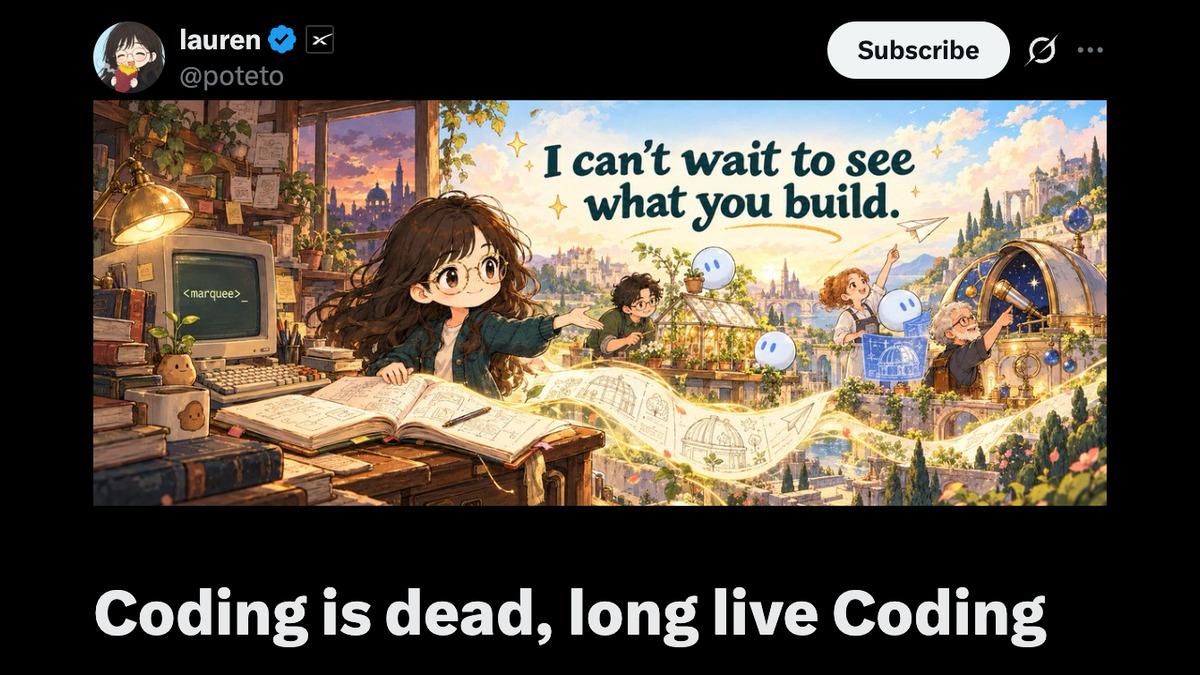
AI is changing how we develop software. AI agents can write more of the code while people describe what they want to build. Software engineer Lauren Tan sees this as the beginning of a period in which many more people will be able to create their own apps, services, and systems.
From self-taught programmer to some of the world's biggest tech companies
Lauren Tan has more than a decade of experience in professional software development. She taught herself to code, studied finance, and has worked at Netflix and Meta.
At Netflix, she worked on internal systems for producing content. She later spent about six years at Meta, where she helped develop React, a technology for building user interfaces for websites and apps. She also worked on React Compiler, which automatically optimizes code.
In 2026, she moved to Cursor, which develops AI tools for programming. She now works on Grok Bot at SpaceXSI.
Coding is dead, long live coding
In an essay on X titled Coding is dead, long live Coding, Tan describes how AI is changing a craft she has cared about since she was a teenager.
She discovered programming in high school when she came across the HTML tag <marquee>, which makes text scroll across the screen. She loved building things, solving problems, and spending time making her code more elegant and her programs faster.
She now sees AI taking over much of that craft.
Tan cites developer Thorsten Ball, who thinks writing code by hand will eventually become uncommon. He compares it to Italian shoemaking. Some people still make shoes by hand, while most people wear shoes made in other ways.
People may still program by hand. Tan's point is that manual coding may become a less common way to develop software.
Why some programmers feel a sense of loss
For many developers, programming is about understanding how things work, solving hard problems, and feeling the satisfaction of getting their own code to run.
As AI takes on more of that work, it can feel like something valuable is slipping away.
Tan thinks that reaction deserves respect. Today's AI builds on the work of the people who created the knowledge, languages, and tools we use. She writes that their craft lives on in AI models, software frameworks, and the programming languages we still use.
She argues for taking seriously the people who are grieving the changes to their craft. There is also room to be excited about what the technology makes possible.
From programming languages to everyday language
Tan imagines a new generation of programmers describing what they want to build in everyday language. She believes they will eventually be able to build things faster and to a higher standard than we could by hand.
She points to a post by Alexander Riccio. He suggests that, in theory, the right combination of instructions could produce the exact code someone wants without manual editing. In Riccio's view, the challenge is finding those instructions.
Alexander Riccio’s post on X, September 25, 2026.
Tan describes how her own technical skills used to limit what she could build. Now, for her, the work is about finding the instructions and giving the AI agent enough context to build what she has in mind.
A new generation of people building software
What excites Tan most is that people who have never programmed can experience the same joy of building things that she discovered as a teenager.
She acknowledges that this can be hard to imagine today. She still believes people building with AI will be able to make things that were previously out of reach.
Tan writes that she loves programming more than ever.
She ends her essay by saying she looks forward to seeing what people build, especially those who have never had the chance to experience that joy for themselves.