
NVIDIA OpenShell and Sentry set boundaries for AI agents
AI agents can write code, use applications, open files, and carry out tasks on their own. How do we keep them from deleting important documents, disclosing sensitive information, or taking actions they haven’t been authorized to take?
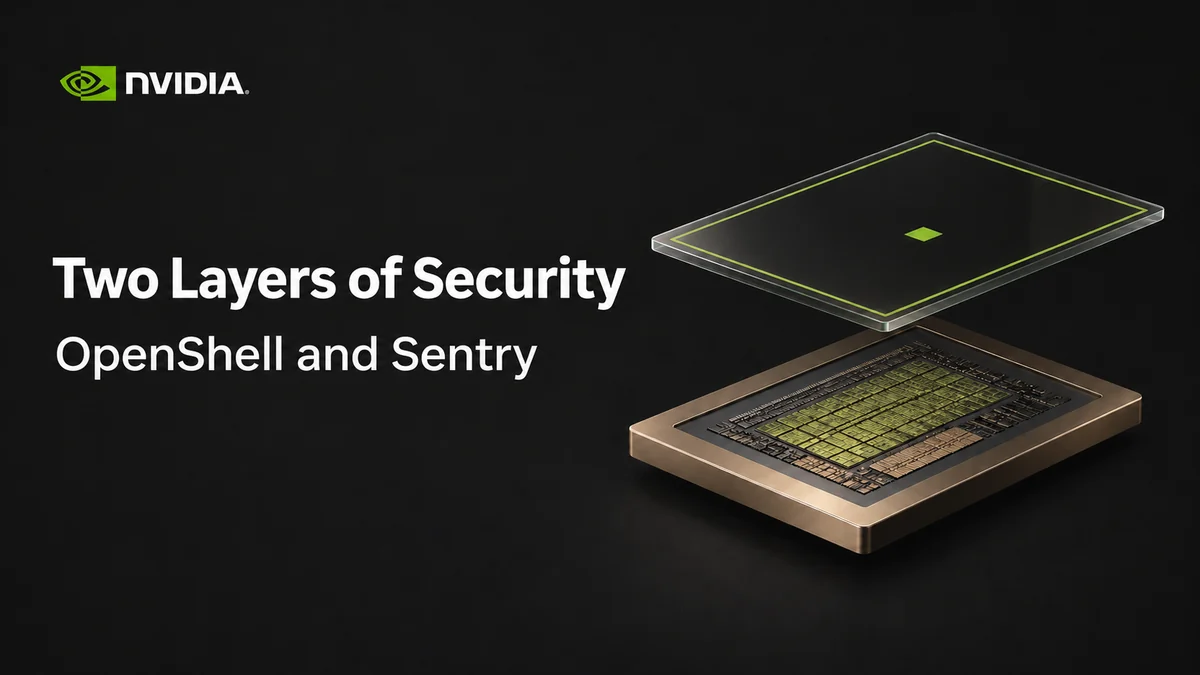
NVIDIA developed OpenShell and Sentry to control what AI agents can access and block actions that break security rules.
The problem with today’s AI agents
An AI agent can plan and carry out tasks using a range of tools. It can open documents, change code, look up information, and communicate with other services.
To do that work, an agent needs access to files, applications, and sometimes entire systems.
Today, people often rely on instructions such as “Don’t delete files,” “Don’t change the main version of the program,” or “Don’t open private documents.”
Instructions alone can’t block an action. An agent can misunderstand the task, make a mistake, or follow malicious instructions it encounters along the way.
NVIDIA wants the software around the model to enforce the rules and block unauthorized actions.
What is NVIDIA OpenShell?
OpenShell is a runtime that enforces security rules for AI agents. It gives an agent an isolated place to work and sets rules for the resources it can use.
That isolated environment is called a sandbox. Software can run inside it with access to only the parts of the system it’s allowed to use.
Say an AI agent is fixing a website. It needs the project files. Private documents, other projects, and passwords can stay outside its reach.
OpenShell lets you define which folders the agent can read or modify, which programs it can run, and which services it can contact over the internet.
Those rules form a security policy.
OpenShell uses security features in Linux, an operating system like Windows or macOS. Those features can block access to files and restrict certain system calls, the requests a program sends to the operating system to perform an action.
The operating system can then stop a request that exceeds the agent’s permissions.
How OpenShell works
Four key parts of OpenShell work together to enforce the security rules.
- Sandbox: The isolated environment where the agent runs. It limits which files and capabilities the agent can use.
- Gateway: The control point for agents, security rules, and access to different environments.
- Supervisor: Checks requests against the security rules. It blocks the connection if an agent tries to reach a service it lacks permission to use.
- Policy Prover: Uses a mathematical approach called formal verification to review proposed network rules. It can flag requests that go beyond the technical boundaries and require manual approval.
The agent runs within boundaries enforced by software outside its control.
OpenShell can also protect credentials such as API keys. An API key works like a digital access card that lets one program connect to another service.
OpenShell can store the key separately and supply it on the agent’s behalf when an approved connection is established.
The agent can use the service without ever seeing the key itself.
What is NVIDIA Sentry?
OpenShell sets the rules for what an agent can do. NVIDIA Sentry adds a security layer that monitors activity and can intervene when behavior looks suspicious.
Sentry is designed for NVIDIA BlueField-4, a specialized chip that handles functions including network traffic and security.
Sentry is designed to run in its own hardware-isolated environment, separate from the host computer’s software.
Think of OpenShell as the access control system for a building. Sentry adds a security team monitoring what happens from a separate, protected room.
Sentry can check communications between an AI agent, the language model, and other services. A language model is the AI technology that interprets information, reasons, and generates responses.
Sentry can also use specialized AI models to spot signs that an agent is drifting from its assigned task.
An agent suddenly trying to send sensitive information to an unfamiliar service could indicate a problem.
NVIDIA says Sentry can block connections and isolate an agent within milliseconds.
Sentry is also designed to keep protected activity logs. Security teams can review what happened and detect attempts to tamper with the records.
NVIDIA describes these capabilities in its technical documentation. Some forms of misuse may still go undetected.
An example from an online store
Suppose an online store puts an AI agent in charge of processing orders.
The agent needs to read new orders, check stock levels, and send order confirmations.
With OpenShell, the company can give it access to the order system and inventory data while blocking it from changing prices, deleting customer records, or making payments.
If the agent tries to act outside those boundaries, OpenShell can stop it.
Sentry can also monitor communications and respond if it detects signs of unexpected or harmful behavior.
The company can automate more of its work while controlling which systems its agents can access.
People still need to set the rules carefully and oversee how agents are used. An agent can make a mistake while doing something it has permission to do.
Can you use OpenShell today?
Yes. OpenShell is available under the open source Apache 2.0 license. Anyone can use, examine, and develop the software under the terms of the license. NVIDIA developed OpenShell and contributed it to the Cloud Native Computing Foundation (CNCF), which publicly welcomed the project on November 10, 2026.
OpenShell works with different AI models and agents, including Codex, Claude Code, and OpenCode. Teams can choose models from other providers.
NVIDIA Sentry is a separate product that requires specialized hardware. In October 2026, NVIDIA said it planned to make Sentry available in early 2027.
Why this matters
As AI agents gain access to more applications and systems, it becomes more important to control what they can actually do.
That matters to businesses of all sizes as they automate work in finance, software development, customer service, logistics, and procurement.
OpenShell and Sentry show how teams can enforce rules around an agent while it works.
Teams can give an agent the access it needs, set technical boundaries, and monitor its actions as it carries out a task.
Agents can still make mistakes. Clear boundaries make it possible to give them more independence while keeping access to systems under control.