
Demand for people who can build and orchestrate AI agents is soaring
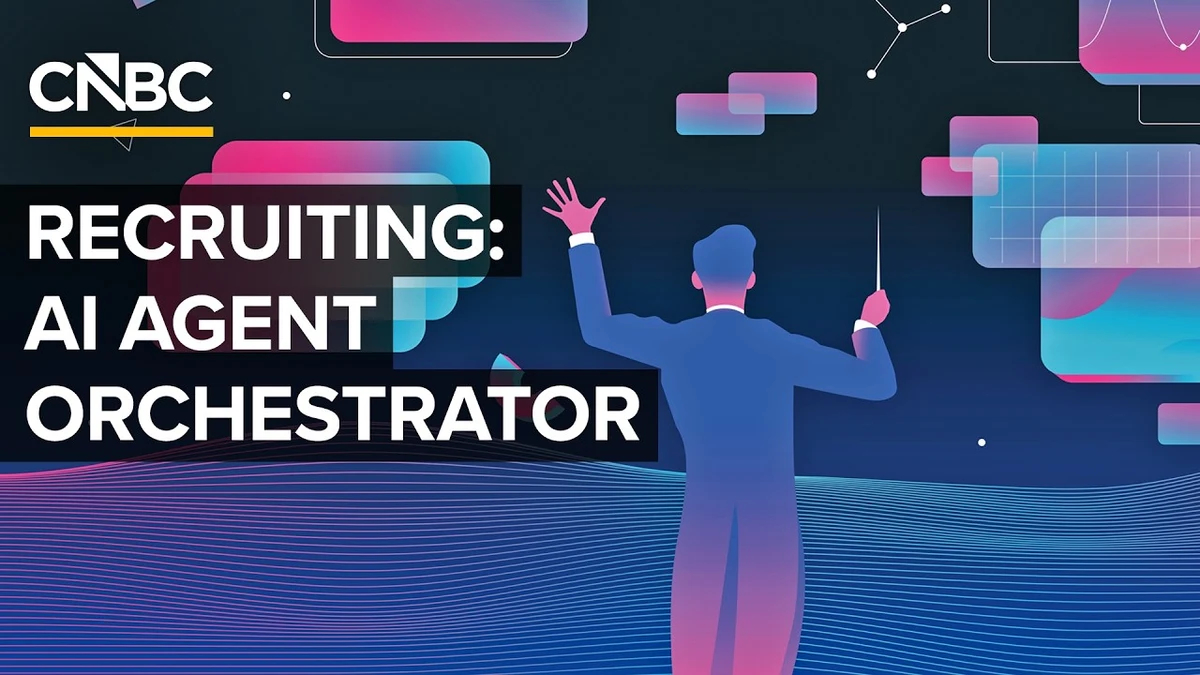
CNBC InternationalNovember 26, 2026Watch the video
This article is based on CNBC International’s video Why AI Agents Orchestrators Are In High Demand.
As artificial intelligence becomes capable of handling more of a company's tasks, the need grows for people who can organize, coordinate, and oversee how AI agents work. This role is often called AI Agent Orchestrator.
According to Randstad’s Tech Talent Report 2026, demand for people with AI agent skills has grown by 1,300 percent, while the number of candidate profiles with those skills has grown by only around 300 percent.
The trend is even more pronounced in banking. Data from analytics firm Draup shows that mentions of agent orchestration in job postings increased by 1,721 percent in 2026 compared with 2025.
What is AI orchestration?
An AI agent can access information, use tools, make decisions, and carry out tasks within a defined area of responsibility. The need for orchestration arises when several such agents have to work together on larger tasks or entire business processes.
An AI agent orchestrator can be compared to an air traffic controller. The controller does not have to know how to fly every aircraft, but must coordinate their movements, make sure they follow the rules, and keep them from getting in each other’s way.
AI orchestration likewise involves defining which tasks agents should perform, what information and tools they should have access to, how they should work together, and when people should get involved.
The role also involves understanding how a business operates, which processes could be improved, and how to divide tasks among people, AI agents, and conventional software.
From chatbot to a digital workforce
Early generative AI services were largely based on people writing instructions and receiving answers. Among other things, this created demand for people with skills in prompt engineering.
With AI agents, software can take over much of this interaction. Agents can retrieve information, use tools, carry out tasks, and delegate work to other agents on their own.
A company can therefore build systems in which several specialized AI agents work together, both in parallel and in a set sequence, without a person having to give new instructions for each step.
In August 2025, research firm Gartner estimated that 40 percent of enterprise applications would have integrated, task-specific AI agents by the end of 2026, compared with less than five percent when the forecast was published.
How it can work in practice
The video Why AI Agents Orchestrators Are In High Demand uses car insurance as an example. Gathering enough information to give a customer an insurance quote can take around 30 steps or more.
An AI agent can communicate with the customer, collect documents, and gather the necessary information. Other agents or software systems can check the details, assess risk, and calculate an insurance quote.
If anything is unclear, the task can be handed over to a specialized agent or a person.
The person orchestrating the system must understand the whole process, define responsibilities, set guardrails, test the system, and monitor results over time.
The same principle can be applied in accounting, purchasing, logistics, customer service, marketing, software development, and many other fields.
Understanding business becomes an important skill
One challenge for companies is finding people who combine technical knowledge with an understanding of business processes, risk assessment, communication, and problem-solving.
Randstad’s report, published October 29, 2026, draws on surveys of 1,100 leaders in eleven countries and analysis of more than 20 million job postings and around 100 million candidate profiles.
The report found the following, among other things.
- 86 percent of surveyed organizations are expanding their technology departments.
- 61 percent find that communication and critical thinking skills are harder to find than technical skills alone.
- 73 percent of job postings prioritize practical skills over formal education.
- Demand for risk management skills has increased by 108 percent.
- People early in their careers with generative AI skills earn a 79 percent pay premium, according to the report.
One person interviewed in the video says he would give greater weight to a candidate’s understanding of processes, systems, business operations, and automation than to their résumé.
This also opens up opportunities for people with experience outside IT. Someone who has spent years in logistics, purchasing, or customer service, for example, may have valuable insight into which processes should change, which tasks can be automated, and where oversight is needed.
More agents do not necessarily mean better results
AI agents can make mistakes, misunderstand information, and make decisions that affect other parts of a system. When several agents work together, errors can also spread through the entire workflow.
OpenAI and Anthropic therefore recommend starting with simple agent-based systems and adding complexity only when it offers a concrete benefit.
Some tasks are best suited to AI agents, while others are better handled by conventional software that follows fixed rules. An important part of orchestration is understanding the difference and choosing the right approach for each task.
Cost, quality, security, reliability, and documentation also need to be considered.
New jobs, but also uncertainty
As demand for AI skills grows, many employees are concerned about what the technology will mean for their own jobs.
A Glassdoor study published in August 2026 found that 53 percent of employee reviews that mentioned AI described it in exclusively negative terms. That is a clear shift from 2019, when 81 percent described AI in exclusively positive terms.
Growing demand for AI skills does not necessarily mean there will be more jobs overall. Companies may need more people to develop and manage AI systems, while needing fewer people to carry out some traditional tasks.
Sources
- Why AI Agents Orchestrators Are In High Demand. The video and transcript this article is based on.
- Randstad Tech Talent Report 2026. Demand, skills shortages, education, and pay.
- CNBC’s How AI is redefining Wall Street jobs. Draup’s figures on the banking sector.
- Gartner’s The Future of Agentic AI in Enterprise Applications. Forecasts for AI agents in enterprise applications.
- OpenAI’s A Practical Guide to Building AI Agents.
- Anthropic’s Building Effective Agents.
- Glassdoor’s How Workers Feel About AI in 2026.