
Why most companies see little financial gain from AI agents
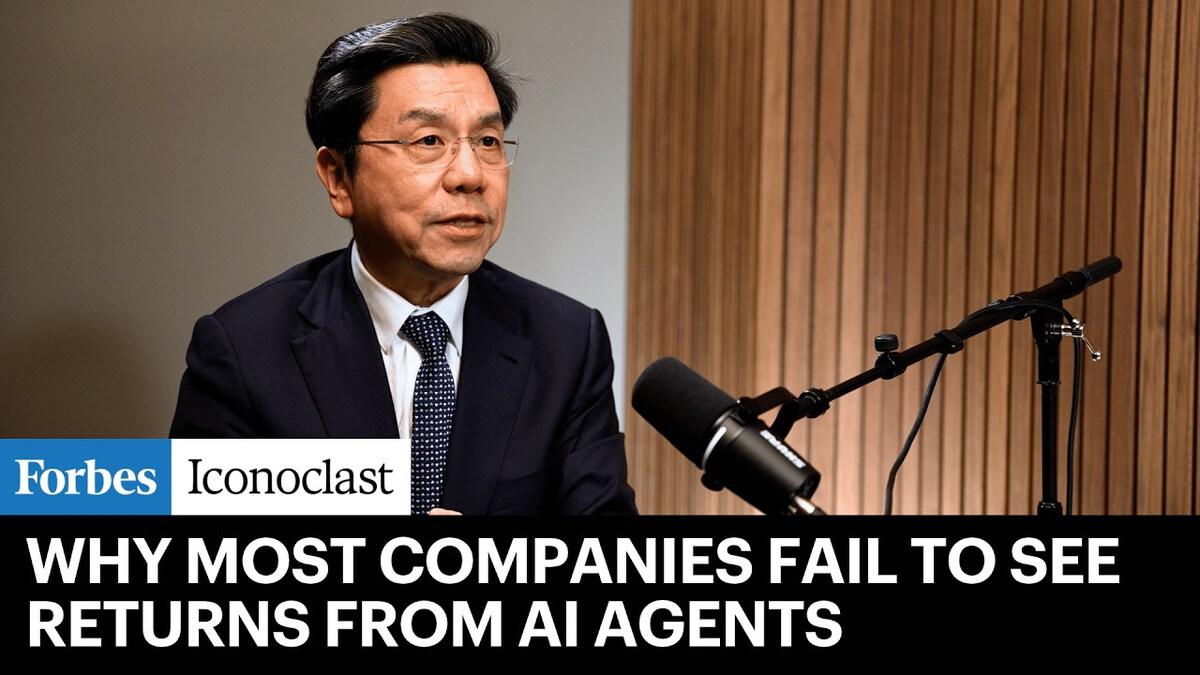
Forbes · Iconoclastwith Kai-Fu Lee (01.ai)November 13, 2026Watch the video
Companies are investing in AI and deploying more AI agents. Yet many struggle to show financial results. AI pioneer Kai-Fu Lee thinks the problem is largely how companies use the technology. Lee says CEOs need to understand what AI can do, use it themselves, and lead the transition. Without that, companies will struggle to realize the financial gains AI can deliver.
Kai-Fu Lee has worked in AI for more than 40 years, including in leadership roles at Apple, Microsoft, and Google. He now leads the AI company 01.ai. In an interview with Forbes, he explains why many companies have seen limited financial gains from AI and why he thinks they need to rethink how they organize and run their businesses.
That argument is also central to his new book, AI Native: The Mandate to Transform Your Company.
What do hundreds of AI agents actually deliver?
Lee recalls conversations with executives who proudly tell him that their companies have deployed hundreds of AI agents. One executive said the company had deployed 700 agents across different departments.
When Lee asked how much this had improved the company’s financial results, he often got no answer.
Lee argues that companies are measuring activity in place of outcomes. They count the number of AI agents deployed and often overlook what those agents contribute.
He points to McKinsey’s research on the gap between productivity and financial gains.
In McKinsey’s August 2026 survey, 80 percent of respondents said AI had improved their individual productivity. Thirty-seven percent reported that AI had contributed positively to their company’s earnings before interest and taxes (EBIT).
Only 6 percent met McKinsey’s stricter criteria for high AI performance. They attributed at least 5 percent of EBIT to AI and reported significant value from the technology.
The survey covers AI broadly. It illustrates the gap Lee describes. Employees can work more efficiently with AI while their company sees a much smaller financial gain.
What AI-enabled and AI-native mean
Lee distinguishes between two ways to adopt AI.
An AI-enabled company gives its employees AI tools to make existing tasks easier while keeping much of the way it works. Customer service uses AI to respond to inquiries, finance automates routine tasks, and employees use language models to write and analyze information.
This can improve productivity. Lee thinks the gains are often limited because the business still operates much as it did before.
An AI-native company organizes processes, decisions, and tasks around what AI makes possible. It asks how the entire process could work differently, including which tasks need to be done in the first place.
Lee argues that the CEO has to lead that transition. IT and individual departments can play a part, but the changes need direction across the company.
Another challenge, in his view, is that many middle managers want to preserve the current structure because they fear losing staff, influence, or their jobs. Some are also reluctant to learn new skills or change how they lead.
Lee says the CEO should take responsibility for the transition, use AI actively, and show the organization how the changes fit into the company’s strategy.
Where needed, he recommends a chief AI officer who reports directly to the CEO. A company whose leadership already has enough AI expertise may be able to handle that work within the existing team.
The goal is to use AI to improve what drives the business, including revenue, growth, profitability, and customer satisfaction, as well as to reduce costs.
An AI that knows the whole company
One of Lee’s examples is Boss AI, a tool developed by 01.ai to advise company leaders.
The idea is to give AI access to information from across the business, including financial reports, customer databases, business systems, meetings, sales calls, and customer service.
Much of that knowledge already exists. It is spread across different systems and in what is known as unstructured data, such as conversations, meeting notes, and documents.
Lee says he has used Boss AI himself for nine months. He can ask what important discussions took place in company meetings over the past week, which products draw the most complaints, and whether anyone is following up on them.
He describes it as a digital chief of staff that can bring information together, spot connections, and help leaders make better-informed decisions.
Keeping information from getting lost between management levels
Lee sees a fundamental problem with how information travels through traditional organizations.
As it passes through several layers of management, important details can be misunderstood, omitted, or intentionally downplayed. Managers may have their own interests, and bad news sometimes stops before it reaches senior leadership.
Lee thinks AI can give the CEO a fuller picture of what is happening by analyzing information directly from company systems, meetings, and conversations.
That could also reduce the need for middle managers whose work is mainly to pass on information, organize meetings, and write reports.
He envisions flatter organizations where people have more responsibility for specific outcomes and AI handles much of the information flow and coordination.
AI could also help evaluate employees
Another part of Boss AI focuses on employees.
Lee describes how AI might analyze performance, track who follows through on commitments, and identify employees who are particularly good at managing AI agents.
He also thinks AI might spot early signs that someone is considering leaving. If an employee who used to take initiative and participate actively in meetings gradually becomes more passive, Lee says the system might interpret this as a possible sign they could leave the company.
This information could help decide who should get more responsibility, a raise, or a promotion. Lee also describes how employees with poor results might be supported through formal performance improvement plans.
These are potential uses Lee describes. They leave open how reliably AI can assess employees’ motivation or predict their decisions.
Extensive analysis of meetings and employee activity also raises questions about privacy and surveillance. Lee describes Boss AI as a management tool and says employees should only be able to see information they are authorized to access.
AI needs to understand how the business works
Lee argues that for a system like Boss AI to work, it needs to understand how the parts of the business fit together.
He uses the term ontology for a structured map of the organization, its processes, responsibilities, decisions, and goals.
That gives the model the context to connect the information it finds in documents to the way the business operates.
Lee says this structure can also help reduce hallucinations, where AI presents incorrect information as fact. 01.ai is developing tools that let users trace recommendations back to their underlying data and reasoning.
This is particularly important when AI is advising on financial and strategic decisions.
Lee also emphasizes that companies should retain control of their knowledge. He thinks they should be able to store their internal knowledge structure in their own systems and keep sensitive information within the business.
The most valuable AI system may be the one that connects a capable model to the right company knowledge. The model’s power is one part of that.
AI agents change the organization and people remain accountable
Lee thinks companies could eventually have far more AI agents than human employees. That would change what they need from traditional management structures.
He envisions flatter organizations where fewer people lead larger groups of AI agents and take responsibility for specific results.
A central role in this structure is what he calls the designated responsible individual, or DRI. This is the person with clearly defined responsibility for an outcome.
A DRI might be responsible for developing a new product, increasing sales, or improving customer service. They can use several AI agents to carry out tasks and remain responsible for directing the agents, evaluating their work, and approving decisions.
AI agents can carry out work. When something goes wrong, a person has to answer for the outcome.
Lee stresses that a DRI must actively lead the agents, assess the quality of their work, and take responsibility for the consequences of decisions. Approving AI suggestions is only one part of the role.
He also thinks companies need to change how they reward people. A DRI who oversees a large share of the business and manages many AI agents should have substantial freedom, along with pay and incentives that reflect the responsibility.
This could become a career path for employees who combine business judgment, leadership skills, and the ability to organize AI agents.
Companies need more than capable AI models
Lee’s own company has changed strategy in response to these developments.
01.ai started out building its own large AI models. It has since shifted its focus to AI tools for businesses.
Lee says competing to build the most advanced foundation models takes enormous investment in computing power. The company also found that capable models by themselves were insufficient to deliver value in large organizations.
Businesses need systems that connect models to their own knowledge, people, and processes.
That is what 01.ai now aims to provide with Boss AI and other systems for sales, management, logistics, and related areas.
When AI improvements build on one another
Lee also describes what he calls an AI flywheel. Better AI helps improve products and services, leading to better customer experiences, more revenue, and new ways to improve the business.
For example, AI might help improve a digital service. Customers have a better experience, usage grows, and the company gets more information it can use to make further improvements.
Repeating the process can increase the gains over time.
Lee thinks this is easier in digital industries such as software, finance, content production, and video, where companies can measure results and implement improvements quickly.
In manufacturing, energy, and mining, it may take longer for the gains to show up. The financial benefits could still be substantial, especially when AI improves large, complex processes in production, purchasing, supply chains, and logistics.
Lee says 01.ai is still working to document the financial impact of its own tools through specific customer cases.
What role will people play as AI does more of the work?
As AI takes on more analytical and practical work, Lee thinks other human abilities will become more valuable.
He points to creativity, judgment, empathy, communication, collaboration, and the ability to make decisions without clear data.
Analysis of past results alone does not always lead to major innovations. Lee cites the iPhone and reusable rockets as ideas that took conviction and a willingness to take risks before the market had shown they would work.
He also acknowledges that AI has developed creative abilities faster than he expected. He once thought creativity would remain largely a human strength. He now expects AI to take over much creative work in areas including graphic design, content production, film, and literature.
He thinks skills in leadership, adaptability, and collaboration will become increasingly important.
Lee also expects many future jobs to be in service roles where human contact and unpredictable situations are central.
He gives plumbers and cleaners as examples. A plumber encounters different problems in different buildings. A cleaner has to adapt to different homes and customers’ needs. Both jobs require practical flexibility and interaction with people.
He also thinks AI will help create types of work that we do not know yet.
The skills people will need include using AI tools, learning quickly, adapting to change, deciding which tasks matter, and leading both people and AI agents.
Key takeaways
For Kai-Fu Lee, the results AI agents deliver are what determine whether a company’s investment pays off.
Giving employees access to AI can raise productivity. Lee argues that larger financial gains also require changing how work gets done, how information is used, and who is responsible for decisions and outcomes.
He expects future companies to be flatter, with more AI agents and people taking greater responsibility for directing them and delivering results.
Companies can use AI to speed up today’s work or redesign the business around what the technology makes possible.