
When everyone can build their own software
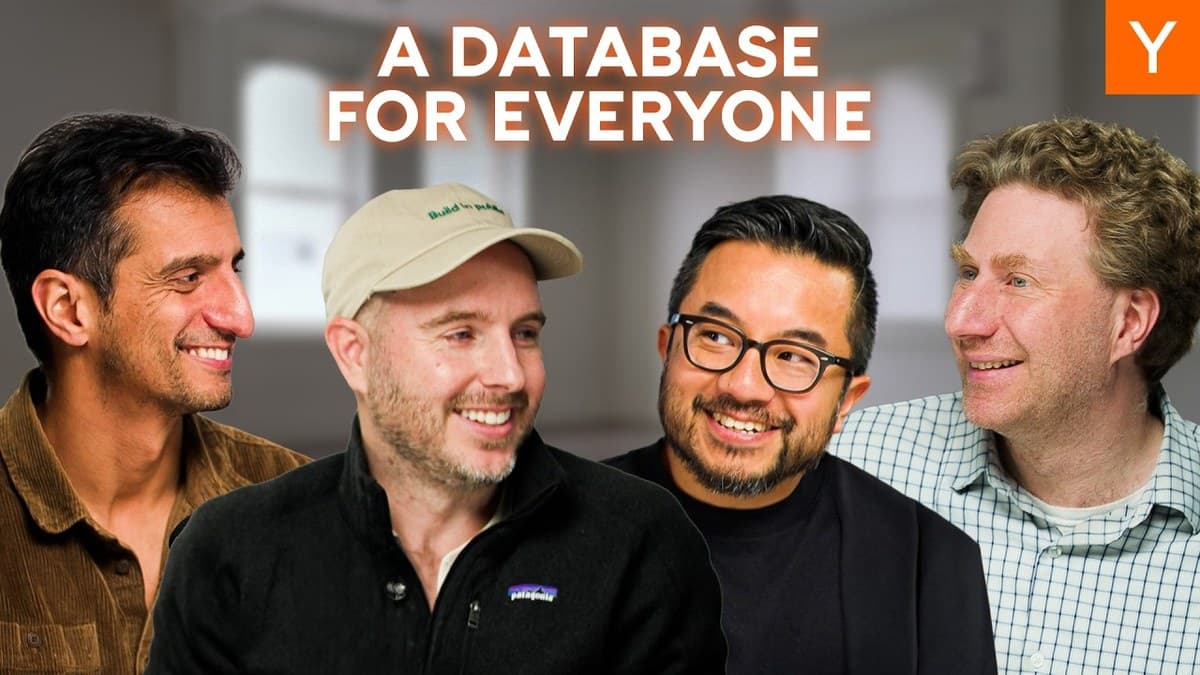
Y CombinatorPaul Copplestone, Garry Tan, Harj Taggar, Jared FriedmanOctober 30, 2026Watch the video
Software development has long been reserved for people who can code, or for people who can afford to pay someone else to do it. Now AI is starting to change that. In a conversation at Y Combinator, Supabase's CEO Paul Copplestone and three people from Y Combinator's leadership explain why more and more people can build their own software, how AI agents, meaning AI programs that carry out tasks on their own, are changing the tech industry, and why knowing what to make could become more important than being able to code it yourself.
That is the starting point of the episode What Happens When Everyone Can Build Software, published on October 30, 2026.
Supabase grows in step with AI development
Paul Copplestone is a co-founder and the CEO of Supabase, a platform that provides, among other things, databases (organized collections of information), user login, and storage for apps and web services. 0:29 You can think of Supabase as part of the engine room behind a digital service. While the user sees the website or the app, the systems behind it make sure information is stored, retrieved, and available to the right people.
In the interview, Copplestone describes rapid growth. Supabase now has around 13 million registered users, up from roughly three million a year earlier. The number of databases the company manages is approaching 50 million, up from around eight million. Over a million new databases are created every week, and Copplestone expects the company's revenue to grow fourfold during 2026.
According to Garry Tan, about 70 percent of the new activity comes from AI agents. The participants in the conversation present these figures, and they have not been independently verified, but they illustrate what is happening.
In the past, a developer had to create a database, configure it, and connect it to the software on their own. Now an AI agent can do large parts of this as part of the job of building an application.
It is not only existing programmers who are making more software. A new group of people is also emerging, people who previously had no way to build their own digital solutions.
You no longer need to be a programmer to be a builder
Copplestone uses the word builders for this new group. 4:34 A builder is a person who makes something digital but does not necessarily know how to program.
In the past, you usually needed a technical co-founder, a developer, or a whole development team to turn an idea into a working product. Now you can describe what you want in plain language and let an AI coding agent write the code, create the user interface, connect to the database, and test the solution.
Copplestone points to a taxi driver from Brazil who had built a local taxi app from his cell phone. The app worked like a small version of Uber, adapted to a local market. The man is a taxi driver himself, and Copplestone does not know why he built the app. But the man was able to build it, and he was very grateful for that. He was about 50 years old but had the energy of a teenager. Copplestone sees this as an example of the excitement among people who were once unsure what the future of work would look like and are now discovering new opportunities.
Another example comes from Harj Taggar. He tells about a founder with a background in finance who used to depend on programmers to develop software. Now this person builds advanced solutions for their own finances, including connections to banks and systems for keeping track of money.
What matters about these examples is not just that AI writes code. It is that the people who know the problems can, to a far greater extent, build and test solutions to them themselves.
Garry Tan therefore believes that the hardest part is no longer necessarily building the software, but knowing what should actually be built. That is a change that could make experience and knowledge of a field far more valuable in software development.
Why buy software when you can make your own?
What the participants call personal software is software made for one specific person and that person's needs. 8:42
Harj Taggar says he has built his own digital control center. There he gathers email, personal finances, health information, exercise, and other parts of daily life in one solution.
He started out using AI agents and plain text files, but eventually found that he needed a database and a visual interface. The result was a personal application that he can keep developing whenever he has new needs.
He himself believes the finance part can compete with the functionality of established personal finance and accounting apps. The advantage is that his own solution can use information from other parts of his life to understand financial transactions and categorize them correctly.
This points to a possible change in how we relate to software.
Traditionally, we have chosen between ready-made products. We adapt the way we work to the features the maker has decided we should have. If something is missing, we can submit a request and hope it arrives in a later update.
With AI, this can be turned around. Instead of adapting to the software, we can to a greater extent adapt the software to ourselves.
That does not necessarily mean ready-made software will disappear. Large services will still have advantages in security, operations, quality, and specialized features. But for smaller and highly personal needs, building something yourself may become more appealing than paying for a subscription to a service with many features you never use.
The personal database could become more important than the app itself
More and more people could come to have their own database. 12:12
Traditionally, databases have mainly been something companies and developers use. The rest of us have had our information spread across different services, such as email, calendars, finance systems, health services, and social media.
Copplestone and Taggar describe a different model. You have one central database with your own information, and you build different apps and AI agents around it.
Copplestone says he has started moving information out of some AI agents and into a more independent database. The reason is that he does not want to be locked in to one particular agent. He wants to be able to switch technology without losing the information and systems he has built up.
If all the information and logic sit inside one particular AI service, it can become hard to switch providers. If the information is stored separately, several different AI models and agents can use the same data source.
At the same time, new demands for privacy and security arise. A personal database in a cloud service does not automatically mean you have full control over the data. Access control, secure storage, backups, and the ability to export information become essential, especially as AI agents get access to more and more sensitive information.
Software now has to be built for AI agents, not just people
Supabase's development shows how AI also changes the companies that supply the technology. 2:35
Copplestone divides Supabase's history into three periods.
First, the company focused on a good visual control panel, so that developers could easily manage databases themselves. Then APIs became more important. An API is a connection that lets different programs communicate with each other and carry out tasks automatically.
Now Supabase is in a third phase, which Copplestone calls code-first. It means that more and more can be controlled through code and text-based tools, without anyone having to click through the control panel.
The reason is that AI agents work differently from people. They often prefer to use code, command-line tools, and direct connections to the services they need.
This has also made Supabase think differently about error messages.
In the past, a developer could get an error message, search Google, read the documentation, and figure out how to solve the problem. Now Supabase wants the error message to contain enough information for the AI agent to understand what went wrong and fix the problem itself.
If an agent tries to do something that fails, the system should not just say that an error has occurred. It should also explain what the agent can do to solve it.
Copplestone describes two challenges for companies that want to become popular with AI agents. First, the model has to choose their service. Then the agent has to be able to use it without getting stuck and choosing a competitor instead.
This could matter a great deal for the tech industry. Today, software companies compete to have the most user-friendly interface for people. Going forward, the ability to work effectively with AI agents may become at least as important.
Copplestone also believes that open source has advantages. When the source code is available, AI agents can in some cases examine how a system works and more easily find the cause of problems. At the same time, business customers get more ability to control the technology they adopt.
When AI writes more code, testing becomes more important
Supabase also uses AI in its own software development. 17:58
Garry Tan refers to an internal survey in which the share of developers at Supabase who used AI agents to write at least 80 percent of their code had risen from about 10 to 60 percent in six months.
Copplestone explains that the company does not have a strict internal AI policy. Developers get access to different tools and choose for themselves how to use them.
But more use of AI also means a greater need for control.
When AI can produce large amounts of code quickly, someone still has to check whether the result works, whether the solution is secure, and whether the changes cause problems elsewhere in the system.
Supabase therefore spends a lot of time on automated tests and so-called evals, systematic evaluations in which different AI models are given specific tasks and the results are compared. Among other things, the company tests which models can build solutions with Supabase, and where they run into problems.
Copplestone says that more and more of the development effort goes into testing specific use cases, rather than just writing new code.
The significance is that the developer's role may gradually change. Less time may go to writing each individual line of code, while more time is spent describing the desired functionality, organizing the system, and checking that the result is correct.
AI also creates a need for a whole new kind of infrastructure
If millions or billions of people start making their own software, the need for databases and other technical services will increase sharply. 15:56
Copplestone uses ChatGPT as a thought experiment. If a very large group of users starts creating their own apps, the need for enormous numbers of new databases every month could arise.
This is a possible future, not a forecast of how many databases will actually be created.
To prepare for this development, Supabase is working on solutions that suit both very small and very large applications.
The company has announced that it is buying Turso, which has developed technology for handling large numbers of small databases efficiently. Copplestone also mentions a planned solution called Supabase Spark, which is meant to make it easier and cheaper to create databases for small projects.
At the same time, the company continues to develop the Multigres technology to handle far larger databases and applications.
The goal is that a person can start with a small experiment and keep using the same platform if the project grows into a large commercial service.
This shows another side of AI development. Even though more and more of the software is written automatically, it still has to run somewhere. It needs storage, data processing, security, and reliable operation. The underlying infrastructure does not disappear just because it becomes easier to make the applications that use it.
AI agents need access to the right information
Garry Tan has a project of his own, GBrain. 32:25 It is a system for organizing and retrieving relevant information from large amounts of documents and personal data.
The background is that AI models have a limit on how much information they can process at once. This capacity is called a context window.
Even with large context windows, it can be impractical to give an agent hundreds of thousands of documents every time it has to solve a task. What the agent mainly needs is the information that is relevant right then.
GBrain therefore uses database and search technology to find the right information and make it available to the agent. This includes RAG, a method in which AI retrieves relevant information from external sources before it answers or carries out a task.
The principle is simple. Instead of AI trying to remember everything, it gets a system that can find what it needs when it needs it.
This could become more and more important as AI agents take on greater responsibility. It is not enough that they can formulate good answers. They must have access to reliable information and use it correctly.
Small companies could get entirely new opportunities
AI could also change the economics of the software industry. 43:32
Traditionally, many technology companies have depended on raising large amounts of capital from investors. The money has gone, among other things, to hiring developers, building products, and financing growth.
Garry Tan believes AI could change this calculation.
He says that some companies that make software for specific industries are now struggling to raise investor capital, even with significant annual subscription revenue. At the same time, he sees possibilities for companies with only 10 to 15 employees to reach revenue levels that would previously have required far larger organizations.
This is his assessment of how the market could develop, not a documented result that applies to all software companies.
The point is still an important one. If AI can do a larger share of the development and operations, a company can become profitable with far fewer employees and less capital than before.
Then the need for investors could also shrink.
Copplestone says he used to see raising capital as an important achievement. Now he believes that managing without outside funding could be an equally great, or greater, achievement.
That could open the door to more small, independent technology companies that develop products for clearly defined needs.
At the same time, running a software company does not automatically become easy. Customer needs, sales, support, security, and further development do not go away because AI writes the code. What can change is how much time and money it takes to get started and deliver a working product.
What will matter most when more and more people can build?
The ability to make software is gradually becoming more accessible. 38:42
Copplestone says he is experimenting with developing software by talking to AI agents, without looking at the code along the way. He wants to experience what it is like to build as an ordinary user with no programming background. He still checks the results to see whether the solution works as it should.
It is also a way to test Supabase. If the company's own tools turn out to be hard to use through AI, he gets direct experience of what needs to be improved.
Garry Tan believes we are still early in the development. AI models are getting better quickly, but the number of people who know how to use the technology to solve concrete problems is not necessarily growing as fast.
Technical understanding will still be important, especially when systems need to be secure, reliable, and able to handle large numbers of users. But for many tasks, knowledge of the problem, the ability to describe a solution, and an understanding of what actually works may become more important than being able to write the code yourself.
Copplestone's advice to companies is to focus on needs that will exist for a long time, while being willing to change how they solve them. Databases have existed for decades, and he believes they will remain necessary no matter how AI develops. What changes is how we build and use the technology around them.
The most important takeaway from the conversation may therefore not be that everyone will become a programmer. It is that far more people could become able to develop software without being programmers.
AI does not remove the need for expertise. It can, however, shift the value of that expertise from the programming itself to understanding a problem, developing a good solution, and making sure it works.
And that may turn out to be a far bigger change than just faster software development.
Key takeaways
- According to Garry Tan, about 70 percent of the new activity comes from AI agents. The figure has not been independently verified.
- Builders are people who make something digital without knowing how to program. According to Garry Tan, the hardest part is no longer necessarily building the software, but knowing what should be built.
- More and more people could have their own database with their own information and build apps and AI agents around it. Then they can avoid being locked in to one particular agent.
- When AI writes more code, testing becomes more important, and software has to be built so that AI agents can use it.
- Small companies could get new opportunities, but that is Garry Tan's assessment and not a documented result for all software companies.
Sources and further reading
- What Happens When Everyone Can Build Software, Y Combinator, The Lightcone, October 30, 2026.
- Transcript of the episode, ulisten.ai.
- Supabase is acquiring Turso, Supabase, October 2, 2026.
- Supabase Select 2026 Recap, Supabase, October 2, 2026.