
Vibe Coding and Agentic Coding Explained
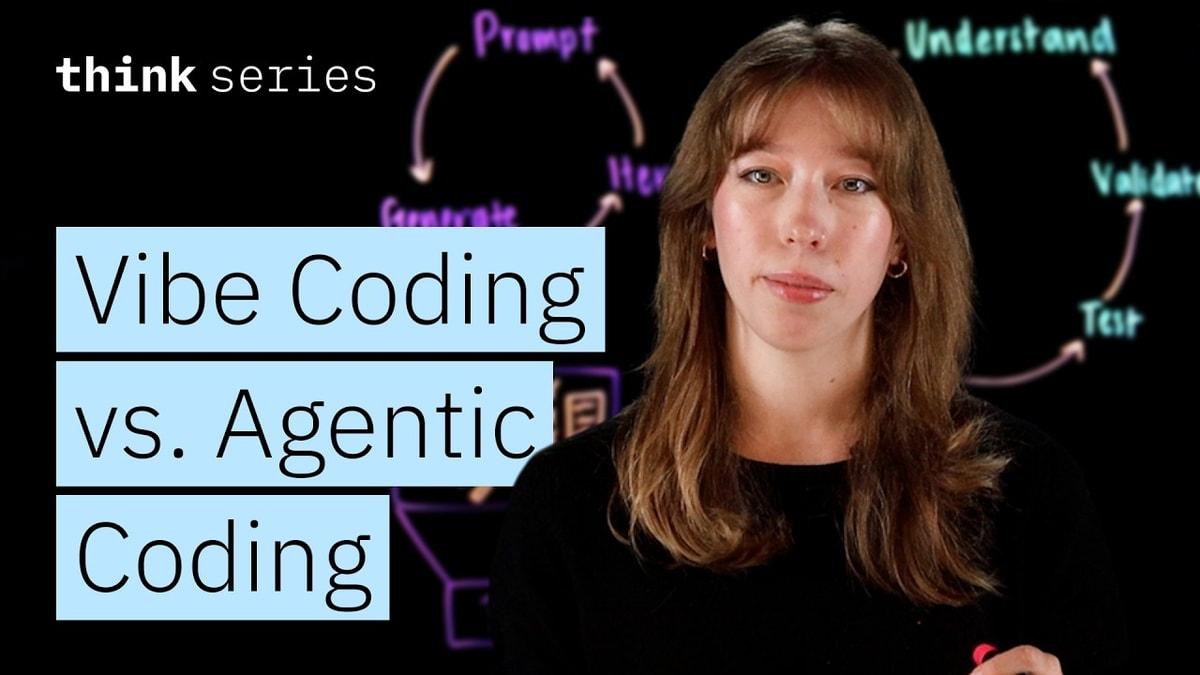
IBM Technology · Think SeriesGrace AbleidingerNovember 23, 2026Watch the video
AI makes it possible to build software without writing the code yourself. Getting something to work is one step. Using AI agents to build software that is tested, secure, and ready for people to use takes more.
Vibe coding and agentic coding describe two approaches to building software with AI. Both are open to people without programming experience. They call for different levels of planning, review, and follow-up.
In brief
- Vibe coding means describing what you want, letting AI write the code, and refining your instructions until the result looks right.
- Agentic coding uses AI agents that can examine existing code, plan changes, implement them, run tests, and check the result.
- You can work with AI agents without writing code by hand. You still need to judge whether the result meets your requirements.
- The more important the software is, the more you need testing, security, oversight, and a way to undo changes.
What is vibe coding?
AI researcher Andrej Karpathy introduced the term vibe coding in February 2025. He described a way of programming in which AI does almost all the coding and the person may never read or understand the code it writes.
Imagine you want to build a website for a photographer. You open an AI tool and type the following.
“Build a modern website with a large photo gallery, a dark background, and a contact page.”
The AI writes the code and shows you the site. The photos look a little small, so you ask it to make them bigger. Then you ask for a different menu, a layout that works better on phones, and a new homepage.
You keep describing what you want while the AI makes the changes.
That is what vibe coding looks like in practice.
You can work from what you see and explain what should change. You do not need to know how the site was coded.
This is useful for trying ideas, making prototypes, or building simple tools.
The problem surfaces as the software gets more complex
A website can look right while parts of it work incorrectly.
The AI may have written unnecessarily complex code, duplicated features, or introduced security issues users cannot see.
If something breaks, you can ask AI to fix it. Without a systematic way to find the cause, it may keep making changes and leave the underlying problem in place.
A more structured process helps at that point.
What is agentic coding?
Agentic coding means using AI agents to carry out larger parts of the development process.
An AI agent can respond to questions and write code. With access to files and development tools, it can also take actions, inspect the results, and use what it finds to decide what to do next.
OpenAI Codex and Anthropic Claude Code are examples of coding agents.
You can give the agent a larger assignment than simply asking for a website.
“Find out how the current website is built. Make a plan for adding a contact form. Implement it, test that it works, check its security, and report what you did.”
The agent can work through several steps.
- Understand. Examine the project, its files, and how the existing site works.
- Plan. Identify what needs to change and which parts of the system could be affected.
- Implement. Write or update the relevant code.
- Test. Run automated tests and fix issues the tests uncover.
- Review. Check the result against the requirements and report what changed.
A small change might take only a few steps. Larger assignments can call for more investigation and testing.
The difference in practice
| Vibe coding | Agentic coding with quality checks |
|---|---|
| Describe what you want | Define the goal and requirements |
| AI generates code | The agent examines the project |
| Look at the result | The agent plans and implements |
| Ask for changes | The agent tests and checks the result |
| Repeat until it looks right | Approve the result when it meets the requirements |
The practical difference is how systematically you develop the software.
The approaches can overlap. You can vibe-code with an AI agent by accepting every change without review. You can also check AI-generated code thoroughly with simpler tools.
Quality depends on how you use the tool.
You can work systematically without knowing how to code
It is easy to assume that agentic coding requires years of programming experience.
Developers have traditionally written code, investigated bugs, and decided how to build the solution by hand. AI agents can take on more of that work.
Someone without programming experience can describe what the software should do, ask AI to propose a solution, and let the agent build it.
You can also ask one AI agent to review another agent's work.
Human judgment still matters.
Imagine you are building an online store. AI can build the ordering system, connect it to a payment service, and test whether the integration works. A person still has to decide how orders should be processed, what should happen when a payment fails, and which rules apply to customer data.
You can work this way without understanding every line of code. You still need to know what the system should do, what risks it introduces, and how you can tell whether it works as expected.
That is a different role from the one programmers have traditionally held.
Multiple AI agents can work together
Agentic coding also lets you divide larger assignments among several AI agents.
Imagine you are building an online store with a product catalog, payments, and order processing.
One agent can look into how to integrate payments. Another can review security, and a third can investigate how orders should be stored.
A lead agent can coordinate these assignments and use the findings to implement the solution.
These supporting agents are often called subagents.
Each can focus on a narrow assignment, keeping the full range of details from falling to one agent.
This relates to what is called context.
Context is the information AI has available while it works, including your instructions, project files, documentation, and earlier results.
Modern AI models can handle a lot of information. Too much irrelevant material can still make it harder to pick out the important details.
Dividing the work lets you give each agent more relevant information.
For many assignments, a single capable agent is simpler and more efficient.
Security matters more as AI takes on more responsibility
An AI agent can get access to more than the source code. It can run commands on a computer, modify files, use external services, and work with databases.
That makes agents useful and raises the consequences of mistakes.
Several basic safeguards help.
Automated tests can check that key features still work after a change. For example, an order should be marked paid only after payment has been confirmed.
Access controls limit what the agent can do. An agent tasked with inspecting a database generally needs read access.
Approvals let people review important actions before they happen, particularly when real customers, payments, or valuable data are involved.
Version history and backups make it possible to go back if a change causes problems.
Logs make it easier to find out what the agent did.
Tests can miss a bug if they never exercise the conditions in which it appears. Technical testing should be paired with checks of how the system behaves in practice.
Karpathy now uses the term agentic engineering
Andrej Karpathy, who introduced vibe coding, has also helped clarify the distinction.
At Sequoia Ascent 2026, he described agentic engineering as a more professional approach to developing software with AI agents.
Karpathy's point is that vibe coding makes software development accessible to far more people. Agentic engineering aims to use those same capabilities while maintaining standards for quality, security, and maintainability.
He sees programmers spending an increasing share of their time directing and coordinating AI agents as the agents take on more of the coding.
The distinction also applies to agentic coding and agentic engineering. Agentic coding describes how agents are used to build software. Agentic engineering puts more emphasis on the full development process that keeps software working reliably over time.
Which should you choose?
Start with what you want to build.
Vibe coding can be enough to test an idea, try out a design, or build a small personal tool. A simple task can stay simple.
Software that handles real customers, payments, personal information, or other important functions benefits from a more structured development process with testing and review.
You can use both approaches within a project. Start with vibe coding to explore an idea, then adopt a more systematic process as you develop the software and put it into use.
What matters is whether you can check the result, regardless of who wrote the code.
Key takeaways
- Vibe coding makes it quick and easy to turn ideas into working software.
- AI agents can do more than write code. They can plan, test, and troubleshoot.
- Agentic engineering uses those agents while maintaining standards for quality and security.
- You can build without programming experience, but you still need to understand what you are building and how to check the result.
- The approaches can be combined. Match the process to the complexity and importance of the software.