
Microsoft unveils six AI models and pursues superintelligence
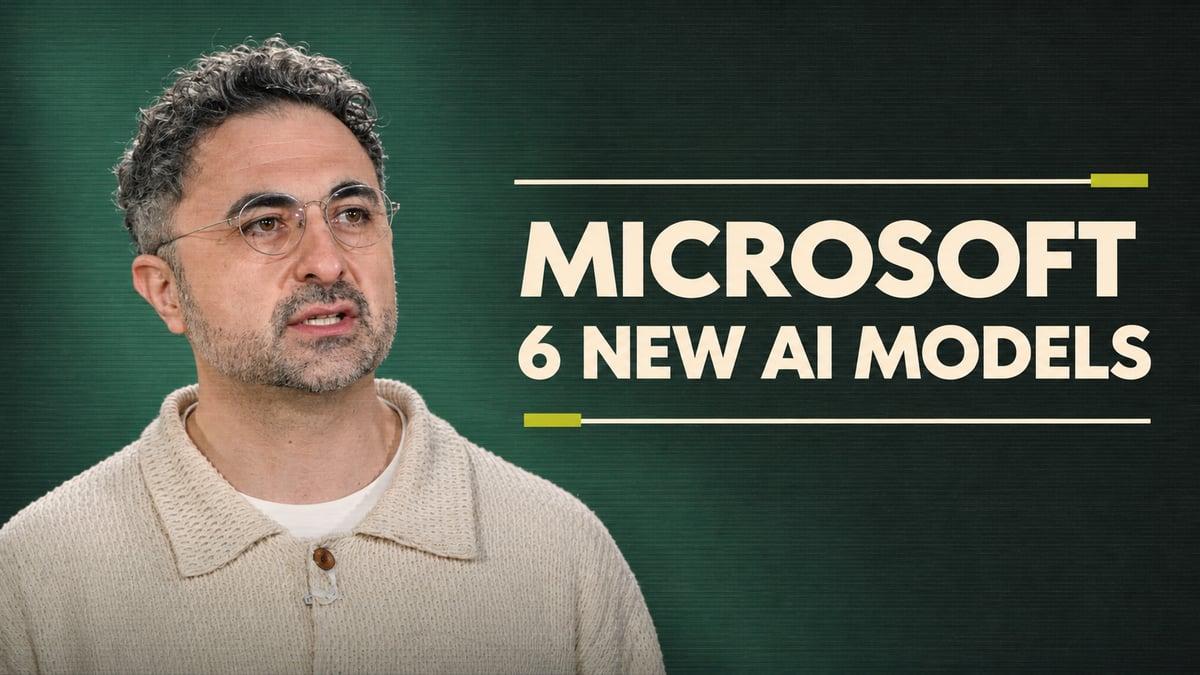
Yahoo Finance · Deirdre Bosa LiveDeirdre Bosawith Mustafa Suleyman (Microsoft AI)November 17, 2026Watch the video
Microsoft has introduced six AI models designed to compete with OpenAI and Anthropic on performance and price. They cover coding, cybersecurity, image generation and editing, and speech. Microsoft is also building a general-purpose AI model to challenge the most capable models on the market. In a Yahoo Finance interview, Microsoft AI CEO Mustafa Suleyman explains the strategy and warns about AI systems that are getting better at building other models.
Microsoft is building its own AI models
Microsoft has long been one of OpenAI's most important partners and investors. It has made OpenAI models available to millions of users through services including Azure, Microsoft Foundry, GitHub Copilot, and Microsoft 365 Copilot.
Microsoft is now developing more of its own models through Microsoft AI, or MAI.
Speaking with Deirdre Bosa on Yahoo Finance on November 17, Suleyman said what customers want most is better performance for the price.
Many companies find that their AI costs rise quickly. Providers often charge by the number of tokens a model processes. Tokens are small units of text or other information. The cost can add up when AI agents handle large volumes of work around the clock.
Microsoft's strategy is to build models that excel at specific tasks. Companies can then reserve larger, more expensive models for work that requires them.
Microsoft continues to offer models from OpenAI, Anthropic, and other providers. It also wants competitive options that it controls.
The six new AI models
Microsoft presented the six models at Ignite on November 17, 2026. They can help developers write code, help security teams find vulnerabilities, generate and edit images, or hold natural conversations.
MAI Code 2
MAI Code 2 is Microsoft's new coding model for larger, more demanding programming tasks.
It can write code, find and fix bugs, make changes across multiple files, and build user interfaces. Microsoft also designed it to understand how the parts of a large software project fit together.
Microsoft reports that MAI Code 2 averages 98 percent of GPT-6.1 Sol's performance at about 40 percent of the price. Against Claude Opus 5.5, Microsoft reports 96 percent of the performance at 5 percent of the price.
The comparison covers four selected coding benchmarks. Its scope is performance on those programming tasks.
Microsoft used a promotional rate with a 50 percent discount for those comparisons. The savings will be smaller at the regular price.
Microsoft says it has yet to optimize the model for scientific research or highly complex agent tasks that run for extended periods.
MAI Code 2 Flash
MAI Code 2 Flash is a faster, less expensive coding model.
It is intended for work developers do frequently, such as explaining code, making small changes, fixing common bugs, and making quick improvements.
Microsoft says the model performs in line with GPT-6 Luna and Claude Haiku 5.5 on selected coding benchmarks at 65 percent and 20 percent of their respective costs. These comparisons also use promotional pricing.
Both coding models are available in GitHub Copilot. Code 2 Flash is also in limited preview in Microsoft Foundry.
MAI Cyber 2 Flash
MAI Cyber 2 Flash is built for cybersecurity.
Microsoft designed it to help security teams and agents review software, identify vulnerabilities, suggest fixes, and detect potential attacks.
Microsoft reports a 92.3 percent success rate on the CyberGym-E2E benchmark. GPT-6 Astra scored 91.5 percent in the same benchmark, and the Microsoft model's cost per task came in under 2 percent of the GPT-6 Astra figure.
Microsoft used GPT-6 Astra as the comparison model. GPT-6.2 Astra is a newer release. The benchmark costs reflect test conditions, and customer costs may vary.
The model has a context window of one million tokens, which lets it review large amounts of code and other information at once.
Microsoft plans to make MAI Cyber 2 Flash available through its own security products starting in mid-December. Initial access will be through those products.
MAI Image 2.7
MAI Image 2.7 is Microsoft's model for generating and editing images.
Microsoft designed it for precise edits to existing images. A user can move an object, change its material, or adjust the lighting while preserving the rest of the image.
Microsoft first showed the model in October. The wider release now supports both image generation and editing.
According to Microsoft, MAI Image 2.7 topped the Artificial Analysis image editing leaderboard on November 16, four Elo points ahead of GPT Image 2.6 Sunburst (max). The margin was small.
Microsoft lists a price of about $35 per 1,000 images.
MAI Image 2.7 Flash
MAI Image 2.7 Flash is a faster, lower-cost version of the image model.
It is designed for high-volume image generation and editing in applications such as online stores, design tools, and automated production systems.
Microsoft lists a price of about $10 per 1,000 images.
Microsoft is also introducing a visual workspace called Canvas, powered by the Flash model. Users can start with a text description or a sketch, then select parts of the image to move, replace, or edit.
Both image models can be tried in MAI Labs and are available in public preview through Microsoft Foundry. They are also offered through OpenRouter and Vercel.
MAI Realtime 1
MAI Realtime 1 is Microsoft's new model for real-time voice conversations.
The model can listen to someone, understand what they say, and respond in speech. It can handle the conversation without separate speech recognition and text-to-speech systems.
It can handle interruptions, background noise, and natural pauses. It can also connect to other systems and carry out tasks.
A customer service agent, for instance, could answer the phone, look up an order, and help the caller with the next step.
Microsoft says the model outperforms GPT Realtime 2.1 on selected tests of conversation quality, speed, and cost.
The base price starts at $0.01 per audio minute. Extra reasoning, which requires more computation, is billed separately.
The model can be tried in MAI Labs. Access through Microsoft Foundry is currently limited.
Microsoft also introduces Decision 1.1
Microsoft's main Ignite announcement counts seven models. It includes Microsoft-Decision-1.1, an updated decision model that is now generally available.
The model scores a set of possible actions and assigns a probability to each option.
Consider a company that gets thousands of customer inquiries every day. Decision 1.1 can determine whether a request concerns billing, technical support, or sales, then help route it to the right department or AI agent.
It can also route tasks to different AI models. A routine task can go to a low-cost model, while a more demanding task goes to a more capable one.
Microsoft reports that Decision 1.1 is 50 times faster than GPT-6.1 Sol and costs one seventy-ninth as much for these kinds of decisions.
Decision 1.1 builds on Google's open-weight model Gemma 4 26B-A4B, which Microsoft adapted.
The model is available through Microsoft Foundry, OpenRouter, and Vercel.
Lower costs could make AI agents much more useful
Microsoft wants models that perform well enough on specific tasks and cost little enough to run continuously.
In the interview, Suleyman describes AI agents that can work independently in the background. They can monitor systems, analyze information, and carry out tasks without waiting for new instructions from people each time.
A security agent could look for new software vulnerabilities around the clock. A coding agent could review changes and catch bugs. Other agents could monitor business data, sort customer inquiries, or prepare reports.
As the cost per task falls, businesses can automate work that used to be too expensive. That is part of the reason Microsoft is investing in specialized models.
Microsoft wants to challenge the best AI models
Alongside its specialized models, Microsoft is developing a large general-purpose AI model.
The company wants it to perform well on many different tasks, much like the most capable models from OpenAI, Anthropic, and Google.
In October, Microsoft published research results for MAI Base 2, a large foundation model it trained in-house. Microsoft said it outperformed every publicly available open-weight model that it tested in its own evaluations.
Those were pre-training results. How a finished general-purpose model would compare with the best commercial models remains an open question.
Suleyman says Microsoft has made substantial progress and hopes to reach the top tier of performance in 2027. He described a goal for performance, with no release date attached.
Microsoft has also revised its agreements with OpenAI, giving it more freedom to develop advanced models of its own. Suleyman says Microsoft already has enough computing capacity for the effort.
Businesses get more control through licensed weights
Microsoft also introduced MAI Licensed Weights, a program that will let businesses access model weights and adapt AI models to their own needs.
Weights are the numerical values inside a model that determine how it processes information and produces results. With access to them, businesses can refine a model using their own data and experience.
This could help companies build specialized systems based on what they know about their own work.
Customers run the models in their own Azure environments. Microsoft plans to make the weights of its most capable MAI models available through the licensing program, which requires Azure.
Suleyman cites security as the reason. He believes increasingly powerful models, particularly cybersecurity models, can be difficult to control if anyone can use them without restrictions.
Suleyman warns about AI that improves itself
Toward the end of the interview, Bosa asks Suleyman about recursive self-improvement.
The term describes a process in which AI systems help develop more capable AI systems, which in turn help improve the next generation.
Suleyman says Microsoft already uses AI models to help develop new ones. They help find bugs, produce training data, and build tests that measure model capabilities.
He says this development warrants serious attention and describes the progress of the past three months as a turning point.
Suleyman is describing AI's role in Microsoft's development process. He warns that those capabilities could eventually lead to systems that independently build more powerful successors.
He says AI companies should be willing to slow development if models gain capabilities they cannot control safely.
People should stay in control of superintelligence
Microsoft calls its long-term ambition Humanist Superintelligence.
Superintelligence refers to AI systems that could outperform people across a wide range of intellectual tasks.
Suleyman argues that such systems should be designed to help people make decisions and leave people responsible for those decisions.
He also discusses handoverism, the idea that people might one day turn over control of companies, institutions, or society to a superintelligent AI.
Suleyman rejects the idea. He argues that people should remain in control of the technology even if AI becomes far more intelligent than we are.
He is also critical of treating AI models as conscious beings with needs and rights of their own. That is his position in an ongoing debate. Whether AI systems can be conscious remains an open scientific question.
For Suleyman, the challenge is to build more capable AI while keeping people in charge of how it is used.
What to take away
- Microsoft is becoming a stronger competitor to OpenAI and Anthropic. It is developing both specialized models and a large general-purpose model.
- Price matters more as agents run continuously. The models need to perform well enough for the work without driving costs too high.
- Six new MAI models cover coding, cybersecurity, images, and speech. Decision 1.1 is a separate model for decision tasks.
- Microsoft's results depend on the tests and prices it used. Some comparisons include temporary promotional rates.
- Suleyman wants people to retain control of superintelligence. He calls for particular caution when AI helps develop other models.
Sources
Primary source
Microsoft's announcements
- Microsoft Ignite 2026 – model overview
- MAI Code 2 and MAI Code 2 Flash
- MAI Cyber 2 Flash
- MAI Image 2.7, MAI Image 2.7 Flash, and Canvas
- MAI Realtime 1
- Microsoft-Decision-1.1 in Microsoft Foundry
- MAI Base 2 – Microsoft's research results
- MAI Licensed Weights
- Microsoft's goals for humanist superintelligence
Platforms, models, and benchmarks
- Microsoft Azure
- Microsoft Foundry
- GitHub Copilot – MAI Code 2 and Code 2 Flash
- Microsoft 365 Copilot
- MAI Labs
- OpenRouter – Microsoft model catalog
- OpenRouter – Microsoft Decision 1.1
- Vercel AI Gateway – MAI Image 2.7 and Flash
- Vercel AI Gateway – Microsoft Decision 1.1
- Google – Gemma 4 model card
- Google DeepMind – Gemini
- Artificial Analysis – image editing leaderboard
- OpenAI – model overview
- Anthropic
- OpenAI and Microsoft – updated partnership agreement