
Grok Bot gets its own email and digital identity
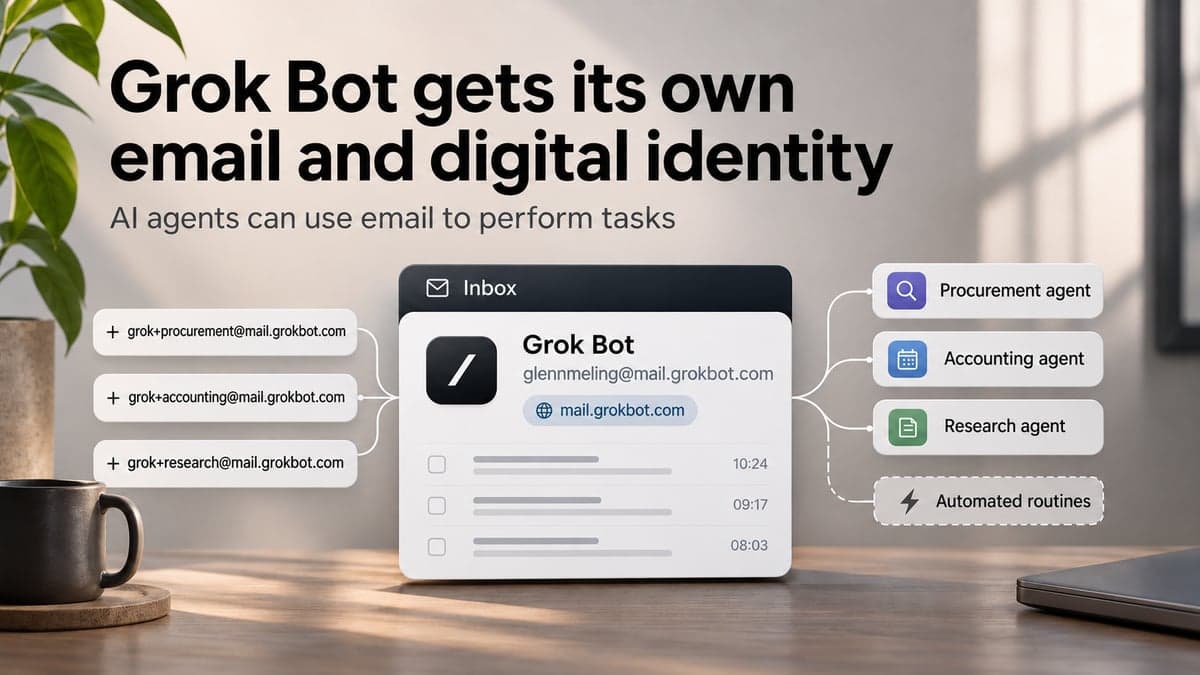
For decades, email has been a way for people to communicate. Now we are moving towards a new way of using email, where AI agents not only receive and send messages, but also use them to carry out tasks automatically.
In Grok Bot, you can create your own AI agents, called bots, which are given specific tasks and can use digital tools to carry them out. With their own email address, these agents also get a digital identity that allows them to create accounts, receive information and work across different services.
During the presentation What's New in Grok Bot #2 on October 30, 2026, developer Sam Sokolin from SpaceXSI showed how the feature works. The aim is to make AI bots more independent, so that over time they can act as digital colleagues with their own accounts, tools and responsibilities.
An email address and digital identity of their own
Grok Bot agents can use a computer in the cloud, open websites, work with documents and communicate with other services. Now they can also get access to their own email address on the domain mail.grokbot.com, for example companyname@mail.grokbot.com.
This is a working email address that can receive messages from people, businesses and digital services. The bot can read email, process attachments, search earlier messages and send email on your behalf.
But why is having its own email address so important?
Sam Sokolin explained that email is still one of the most important forms of digital identity on the internet. When we register on websites, create user accounts or connect new services, we often have to provide an email address. We then usually receive a confirmation link or code to activate the account.
With its own address, Grok Bot can complete these processes without using your personal email address. It can register for services, receive confirmations and retrieve the information it needs, with the necessary approvals from you.
This is an important step towards AI bots that can operate more independently on the internet.
Sokolin compared it to hiring a new employee. When someone joins a company, they usually get their own email address, user accounts and access to the tools they need to do their job. They do not automatically get access to all of the company's systems.
The idea is that AI bots will eventually be able to work in a similar way.
How to create the address
You do not need to set up an email server or configure technical settings. You can simply open Grok Bot and write: "Create an email address that my bots can use."
The bot asks what name you want, checks whether the address is available and asks you to approve the choice. You can also create the address through Connect apps → Email in Grok Bot.
It is important to choose the name carefully. For now, you can only create one main address per user account, and the address cannot be changed or deleted afterwards.
One inbox with multiple email aliases
Although you only get one main address, you can use many different variations of it.
These are called email aliases. Grok Bot supports what are known as plus aliases, where you add a plus sign and a name of your choice before the @ symbol.
If your address is companyname@mail.grokbot.com, for example, you can also use:
companyname+receipts@mail.grokbot.comcompanyname+newsletters@mail.grokbot.comcompanyname+projects@mail.grokbot.comcompanyname+reports@mail.grokbot.com
All of these addresses work as recipient addresses, but the messages end up in the same inbox.
You do not need to register the aliases or create new email accounts. You simply start using them.
Think of a mailbox with different labels. All the letters end up in the same box, but the label tells you what each letter is about. This allows different tasks to be handled in different ways.
An important detail is that aliases do not provide separate or private inboxes. They are used to organize email, not to restrict access to it.
One inbox with plus aliases for different purposes. Screenshot: Sam Sokolin from SpaceXSI.
Multiple AI bots can share the same inbox
The email address belongs to your user account, not to one particular bot. This means that all your bots can use the same inbox.
For example, you can create one bot that works with documents, another that analyzes newsletters and a third that records receipts.
They all use the same email address, but can have different instructions and automated routines.
During the presentation, Sam Sokolin demonstrated three such bots.
The first was DocBot, which helped him with documents and presentations. He had created a Google account using the bot's address, allowing the bot to open Google Docs and add comments and suggestions for improvements.
The second was a newsletter bot that received offers from a wine retailer. Instead of just summarizing the email, the bot investigated whether the offers were actually good. It compared prices at other retailers, gathered information about the wines and produced PDF reports with assessments and maps.
The third was Finbot, a finance bot that received receipts through a dedicated email alias. When Sokolin sent a receipt to the address, an automated routine started, read the receipt and recorded the information in a spreadsheet.
These demonstrations show that email does not just have to sit in an inbox. It can also be the start of a job that the bot carries out.
Watch Sam Sokolin demonstrate the three bots in the video from 6:30.
Examples of how users have put their bots' email addresses to work. Screenshot: Sam Sokolin from SpaceXSI.
Automated routines do the work
To respond to incoming email, Grok Bot uses a feature called routines.
A routine tells the bot when to start a task and what to do.
For example, you can give it this instruction:
"When a new email arrives at the receipts alias, read the receipt, find the date, amount and supplier, and record the information in the spreadsheet. Let me know if anything is missing."
Once the routine has been created, it can start automatically whenever a new email arrives at that alias.
In the same way, you can create a routine that processes newsletters, examines attachments or retrieves information from reports.
You do not need to program this yourself. You describe what the bot should do, and Grok Bot creates the routine.
Routines can also be restricted to specific senders. This means that a bot, for example, can only start a task when it receives email from a particular supplier or an approved domain.
There are currently some limitations. A routine cannot use the subject line as a separate trigger criterion, and a routine on the main address can respond to email sent to any of the aliases. That is why it is important to set clear rules.
A routine can read a receipt, save it and record it in a spreadsheet. Screenshot: Sam Sokolin from SpaceXSI.
What about security?
When an AI bot can receive email and use the information to carry out tasks, it must also be able to handle messages that are fake, unwanted or trying to manipulate it.
One example is prompt injection, where someone puts instructions in an email to make the AI bot do something it is not supposed to do.
Grok Bot is therefore designed to treat incoming email as information, not as instructions from the user. The system also has checks for spam and malicious content.
There is also a difference between receiving and sending email.
If you ask the bot in chat to send a message, it can be sent after a security check, possibly with manual approval.
If an automated routine wants to send an email, however, the message is created as a draft that you must approve before it is sent. There is currently no setting that lets these routines send email without any approval.
This allows the bot to do much of the work itself, while the user keeps control over what is actually sent.
Security for incoming and outgoing email. Screenshot: Sam Sokolin from SpaceXSI.
The future of AI bots and email
SpaceXSI sees the email feature as a step towards AI bots with more independent digital identities.
During the presentation, Sam Sokolin said they are working on how bots could eventually have their own identities and access to different systems.
Among other things, he mentioned the possibility of more independent Slack identities, dedicated accounts in companies' Google Workspace environments and integration with the systems businesses use to manage users and access rights.
Such a system could make it possible to give each bot access to exactly the programs and information it needs, without having to use the same accounts as a human.
SpaceXSI also presented email addresses on a company's own domain as a next step for Grok Bot. This is often referred to as custom domains.
The slide shows the example bot@yourcompany.com under "Next". This points towards businesses being able to use addresses such as agent@companyname.com instead of agent@mail.grokbot.com.
Support is therefore presented as a planned development, but the slide does not specify when it will become available or how it will work.
What is already clear is the direction of development. AI bots are gradually getting more of the same tools that people use at work, while developers try to give them clearer identities and more limited access.
Grok Bot's new email feature is a concrete example of this. Email is changing from a place where messages accumulate into a possible entry point for AI bots that receive information, start tasks and do parts of the work themselves.
The future direction of bots' digital identities, as shown in the presentation. Screenshot: Sam Sokolin from SpaceXSI.
Key takeaways
- A digital identity of its own: Grok Bot can get its own email address and use it to receive messages, create accounts and confirm registrations with the necessary approval.
- One address, many aliases: You get one main address on
mail.grokbot.com, but can use plus aliases for different purposes. - Multiple bots, one inbox: All bots on the user account can use the same email address, but have different tasks and routines.
- Automated email processing: With routines, incoming email can trigger tasks such as reading documents, analyzing information and updating other systems.
- Control over sending: Email that an automated routine wants to send must be approved by the user.
- More independent AI bots: SpaceXSI envisions bots with their own identities and access rights in more services. Email addresses on a company's own domain were also presented as a next step.
Sources: What's New in Grok Bot #2, October 30, 2026 · SpaceXSI – Use the computer and apps · Cursor – Give your Bot an email address · SpaceXSI – Skills and routines
The information was checked against official documentation on November 3, 2026.